
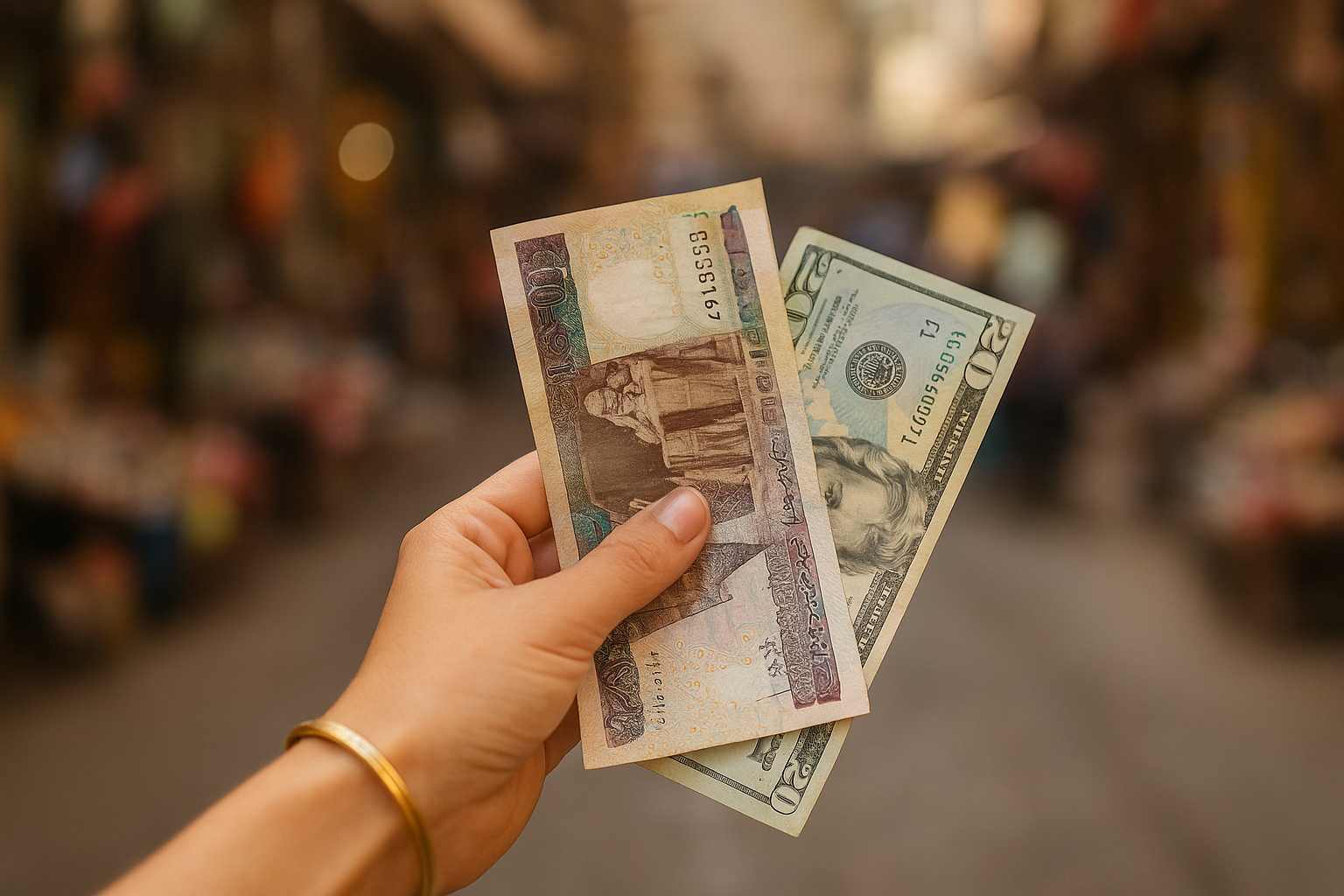
Quick Answer – updated 30 May 2026. Bring cash in your home currency (USD, EUR, GBP, AUD) and exchange it for Egyptian pounds after you arrive. Use pounds for daily expenses (snacks, taxis, tips) and keep some foreign cash for hotels or tours. Always carry both cash and a card for backup. Don’t bring coins — they’re useless here. Learn the one simple thing to never do at the airport exchange and the one time you SHOULD use card.
How Much Egyptian Currency To Bring to Egypt?
None! I am constantly asked this question by my guests about a week or two before they arrive. The answer is “None!” Do not change any money to Egyptian currency in your own country.
Apart from the fact that you will get better exchange rates and no fees at any of the many currency shops or banks here – THERE IS A HEAVY PENALTY FOR BRINGING IN MORE THAN 5,000 LE.
5000LE = US$95 or €82
Given that low rate it is very easy to fall foul of this restriction regarding Egyptian money.
How Much Foreign Currency Can I Bring Into Egypt?
You can bring in as much foreign currency – US dollars, Euro, British Pounds etc. as you like. However, you are required by law to declare anything in excess of US$10,000. You also need to keep the customs receipts and any paperwork associated with the declaration. You may be asked to account for how you spent that money on leaving the country.
Top Ten Tips on Saving Money in Egypt
- Don’t buy it before you travel because you will get a better exchange rate inside Egypt AND no exchange fees.
- Bring a good backup of your own currency if it is US dollars, Euro, British Pounds, Australian Dollars.
- You must have US$, Euro, British Pounds or AUD (these are the main ones) if you are getting your entry visa on arrival at the airports. Easiest thing to do is pay for your entry visa with $100 and your change will be in Egyptian pounds, enough to see you through the first few hours for tips, snacks, taxi etc.
- Bring new $100 bills as opposed to old or damaged ones.
- Don’t bring coins – get rid of them by stocking up on non-meltable snacks, books etc. at the airport to lighten your pocket load.
- Change ONLY a little ($50) at the airport bank in the arrivals hall. After that use an exchange shop, ATM or bank to withdraw Egyptian pounds. Remember, cash is king in Egypt.
- Pay for your hotel and tours in the currency you were quoted in.
- Pay with card for high cost items.
- Exchange money every few days to avoid having excess Egyptian pounds at the end of your stay.
- ATMs will give you back-to-back withdrawals.
The Reasons Behind My Top 10 Tips
Using Dollars, Euros, Sterling
Hotels and big shops accept USD, EUR, GBP, AUD. But for taxis, water, and market stalls Egyptian pounds is best for you so you don’t get caught on the exchange rate.
There are some older dates on the US $100 bills that will not be accepted by Egyptian banks or exchange shops, so you need to bring new $100 bills and make sure none are damaged — they won’t be accepted either. Sometimes you might be asked to change one of those notes for a newer one or for Egyptian money because the person can’t change it in Egypt, but you can back home.
How to Get the Best Rate
- Exchange shops — they are EVERYWHERE (passport required, shorter lines than banks).
- ATMs — watch withdrawal limits, but remember:
- You can make back-to-back withdrawals. ATMs have withdrawal limits but most will let you make consecutive withdrawals there and then, up to the limit your home bank allows.
- Not all ATMs have the same limits. The ones built into bank walls have higher limits than those in or outside hotels because they are easier to keep fully stocked. A very few will give you US dollar withdrawals but this is not the norm.
- Don’t leave ATM runs until the morning — they can run out of cash, and you don’t want to be using foreign currency for small transactions during the day.
- Airport banks — don’t change much here, maybe $50, because their rate can be slightly less favourable than exchange shop rates, and exchange shops are everywhere.
- Visa & Mastercard: widely accepted in hotels and restaurants, rarely in small shops. Don’t use your card in any shop presenting you with an old-fashioned card-copying machine, and don’t hand your card to anyone to process in a back room or behind a counter. Always have a cash backup. If you’ve already agreed a good price, be polite when switching to cash — just say you remembered you have it.
- AmEx: limited use.
- Contactless (Apple Pay, Google Pay): only accepted in a few larger establishments.
- Traders add fees for cards — expect around 3% more.
Paying for Accommodation
By law, hotels and tour operators in Egypt must be paid in foreign currency — so don’t expect to settle your bill in Egyptian pounds.
Pay in the currency you were quoted in. This sounds simple, but it’s a common trap. If a hotel quotes you in US dollars but you’re travelling from a euro-zone country, pin down both the quote currency and the payment currency before you commit. Leaving the conversion to the hotel receptionist on arrival almost always means an unfavourable rate. With the euro and dollar fluctuating as sharply as they have in 2026, the difference can be significant — sometimes within the same week.
Check whether your hotel is cash-only. Some smaller hotels and guesthouses won’t accept cards at all, so it’s worth asking before you arrive.
A note on how we handle it at Mara House: We quote in euros, but we accept payment in your home currency using the mid-market rate from XE Currency Converter on the day you pay. It’s the fairest way we know to do it. Not every hotel works this way though — if you’re paying cash elsewhere, ask upfront how they calculate their exchange rate. If they’re vague, assume it favours them, not you.
Small Change is Gold Dust
You’ll constantly need small notes (1, 5, 10, 20, 50 LE) for taxis, tips, and snacks. Hotels and banks rarely have them.
TIP: Ask small vendors (fruit sellers, bakers, juice stalls — these are normally not trying to make extra money from tourists and are happy to oblige) to break your notes, as it also lightens their cash drawer.
Coins
Don’t bring foreign coins. Banks won’t take them. If locals show you foreign coins, they are not begging — they’re asking you to swap them for Egyptian notes. But the 1 LE coin looks a lot like the 1 Euro coin — if you decide to help and change their coins, check carefully.
Egyptian coins — especially the 1 LE coins — accumulate fast. We all tend to empty our pockets at the end of the day and they pile up on the table. Remember to spend your Egyptian coins in the days before you leave.
Use Card Only for Certain High-Cost Purchases
Here’s a currency tip almost nobody tells you: don’t assume that paying by card is best for everything expensive. But there is one time it is definitely worth it — when paying for items where you might feel a bit unsure, like high-end gold and silver jewellery.
Egyptian jewellery is stunning — but unless you’re carrying a jeweller’s magnifying glass, know the daily market price of gold and silver, and can weigh pieces precisely, there’s no way to be certain you’re not overpaying. Most gold here is 20–22 carat and often not hallmarked. Prices should be calculated on the metal’s weight, daily value, and the craftsmanship involved. That is how it is calculated for Egyptian customers.
A personal story: several years ago, I bought some plain gold bangles in Egypt. The lack of hallmarks worried me. Several local jewellers at home doubted they were real gold. I set them aside and tried not to think about it — until a trip to Dublin gave me the chance to check. At the Assay Office, I was relieved to learn they were indeed 22-carat gold. They even advised me to have them hallmarked myself — which I did.
I was lucky. But imagine buying a beautiful piece that breaks, gets damaged, or turns out to be lower quality than expected — or worse, only gold-plated. Paying by card gives you a safety net. At least there’s a possibility of some chance for redress.
Practical Takeaway
Bring a mix of: foreign cash (USD/EUR/GBP/AUD), Egyptian pounds (get them here), and one solid Visa/Mastercard. That’s your safest bet.
See my full Travel Advice Hub for answers to all your questions on Egypt.
Last updated on 03/06/2026 by Marie Vaughan