
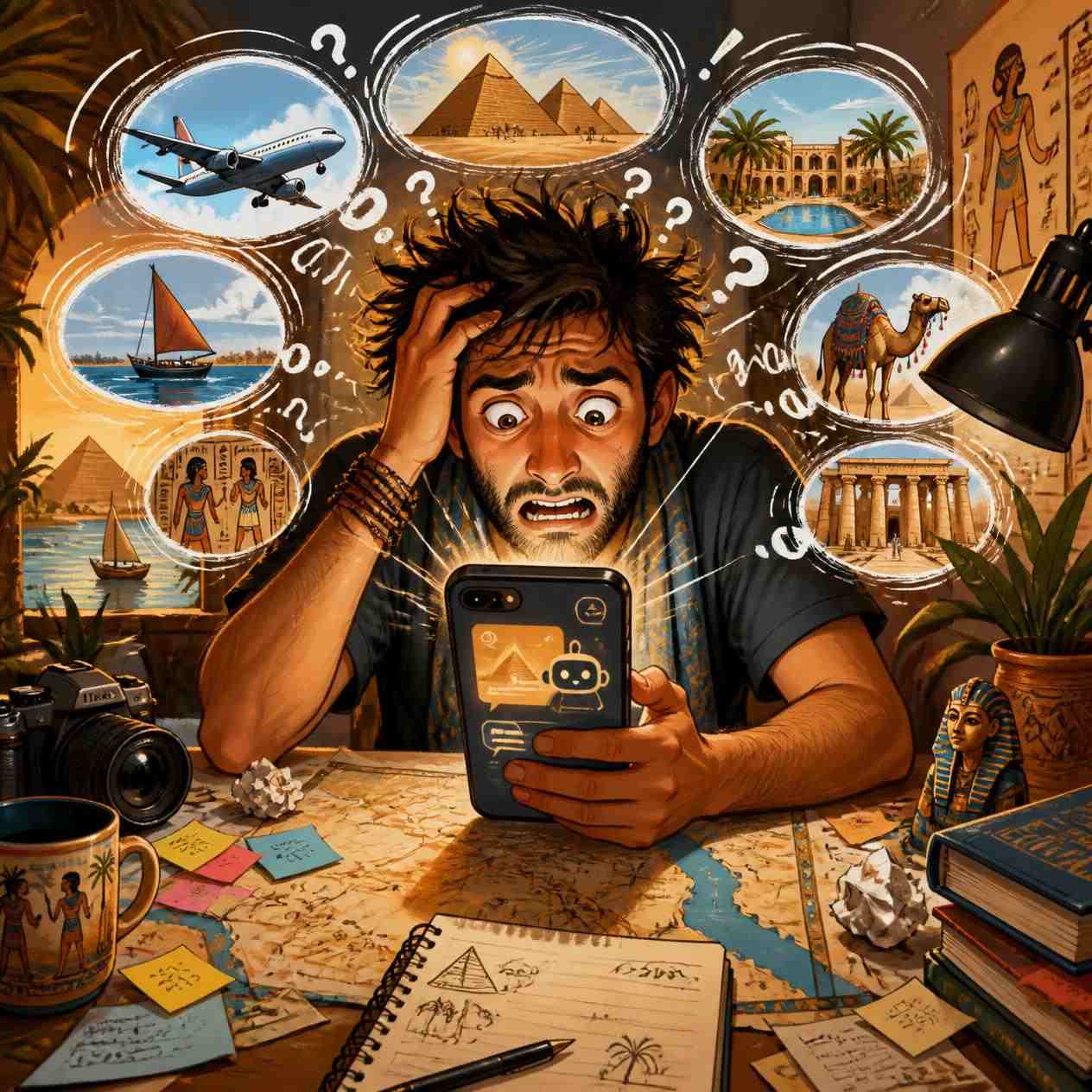
There is a new way of planning a trip to Egypt that I see more and more: its called “ask AI”.
And actually, I think AI is extremely useful for the first part of the process. You can ask it what there is to see in Egypt, where the major sites are, how long it takes to get between places, which temples are most visited. And that is where your dependence on AI as a trip planner should end. AI gathers its information from what is published on the internet – the internet is full of good stuff – it is also full of rubbish and misleading information. AI cannot tell the difference. AI has not been to Egypt. If you ask AI “what is the best…?” for any product, it can only give you the opinions of others – you have no way of knowing if your interests align with those opinions.
I will tell you something about Egypt – millions of people have visited, and nearly all of them have visited the same handful of maybe 20 sites out of the thousands scattered across the country. That is all AI can give you back – it takes the majority consensus and plates it up for you. Travel agents and tour operators are happy with this – it’s routine, it’s normal and it pays well. And while the major sites is what many people want – is that what you want from your visit to Egypt? Or do you want more?
Itinerary Planning from AI
If you ask AI to give you a 7, 10 or 14 day itinerary, it will crawl the top travel agent sites first and give you the standard itinerary. That is where you really, really do need to stop with AI. Get in touch with the travel agent that AI cited and book your trip. You stand a 50% chance of success.
The problem comes when you keep asking AI to add things.
“Can we fit Abu Simbel in?”
“Yes.”
“What about Alexandria?”
“Yes.”
“And a Nile cruise?”
“Yes.”
“Could we also see the Red Sea?”
“Certainly.”
“What about a balloon ride?”
“Absolutely.”
“And perhaps another temple on the way?”
“Of course.”
Before you know it, you have an itinerary that looks fantastic on the screen and would be completely exhausting in real life – actually, it would be impossible. How do I know? Because I have been given these itineraries and asked to price them. I refuse to do so anymore because they don’t even make sense. Yes, they sound absolutely divine – but they are genuinely not possible once you factor in getting from one place to another and the timing AI has handed you. What I end up doing with these AI itineraries is rewriting them from start to finish, and nine times out of ten, telling the sender to forget the trip if they are hell-bent on believing AI has given them anything workable.
AI is very good at adding. It isn’t good at saying no.
That’s an important distinction. An AI itinerary can tell you that something is possible. It doesn’t necessarily mean it is sensible.
Google Maps may tell you that two places are three hours apart. An itinerary generator can happily put them on consecutive days. Neither one has experienced what it is like to get up at 4.30am for the third morning running, sit in traffic, walk around an archaeological site in the heat, eat lunch in a coach restaurant and then do it all again the following day.
The information can be completely correct. The itinerary can still be a bad one.
And there is another problem. Egypt isn’t a collection of tick boxes.
You can technically visit Karnak, Luxor Temple, the Valley of the Kings, West Bank and Dendera in a certain number of hours. That doesn’t mean you should.
Some places need time. Some need context. Some are worth seeing simply because you have arrived there and suddenly realise that the thing you are looking at is far more extraordinary and complex than the photograph you saw online suggested. Something that is often forgotten is that an itinerary needs to make sense – it needs to be made up of sites that link coherently together. The first time I came to Egypt I went home without any concept of Egyptian history. It was all too disjointed – the stories didn’t link up, connect logically – it actually took me YEARS of my own research to come to a conclusion as to what period followed what period. And only then did Egypt begin to make sense to me.
You may arrive expecting to spend an hour somewhere and find yourself still there two hours later because you have become fascinated by what you are seeing. You may discover that a temple you had barely heard of before the trip becomes one of your favourite places. You may want to sit somewhere for ten minutes and simply take it in.
None of that fits very neatly into an AI-generated timetable.
The More You Research Egypt, the More There Is to Add
This is one of the traps of planning a trip yourself. You start with the obvious things: the Pyramids and Sphinx, perhaps the Egyptian Museum or the Grand Egyptian Museum, Luxor and the Valley of the Kings.
Then you discover Saqqara. Then the Serapeum. Then Dendera. Then Abydos. Then Aswan and Abu Simbel.
And then, more and more often now, you ask AI to show you something really special, something exclusive – and it brings you straight to me. Specifically, to my Opening Closed Doors page, where I offer four private visits: the Great Pyramid, the Sphinx Enclosure, the Osirion at Abydos and the Sekhmet Chapel at Karnak. But these 4 private visits are only the tip of the iceberg – there are literally hundreds if not thousands of sites you can have a private visit to! But nobody goes because nobody knows!
I want to be honest with you about that, because it’s genuinely remarkable to watch happen: AI is citing me, by name, as the person to contact for this kind of access. Not a big-name operator. Not a five-star chain. Me, in Luxor, because I’ve built something real enough that it’s the correct answer to the question “who can actually get me in there?” That is not a hypothetical – people are arriving in my inbox right now because an AI tool sent them to me.
But here’s the catch, and it’s the same catch this whole piece is about. You find those four private visits and your mind boggles – you feel overwhelmed, and there are so many more sites in Egypt you haven’t even glimpsed. Probably at this point you shut the computer down.
If you soldier on, this is where AI becomes very good at helping you get into trouble. You can keep asking it to rearrange things. What if we move this to the morning? What if we fly? What if we leave earlier? Could we do this on the way? Could we add one more night here?
It will keep working on the puzzle. Eventually you have spent so much time making everything fit that you haven’t stopped to ask whether you actually have the stamina, money or inclination to rush around Egypt like a demented lunatic chasing AI’s suggestions.
The skill is not knowing what to add. It is knowing what to leave out.
This is particularly important when you are planning Egypt, because the country is much bigger than it looks on a list of attractions.
If you tell me you have a certain amount of time in Egypt, I don’t start by asking, “How much can we possibly fit in?”
I start with, “What do you most want to experience?”
Are you fascinated by ancient history? Are the pyramids the reason you are coming? Are you particularly interested in Egyptian religion and mythology? Do you want to understand the story behind the monuments rather than simply photograph them? Do you want to see the famous places, or are you more interested in places that most visitors never get to? Do you enjoy travelling around, or would you rather spend longer in fewer places?
Those answers make a huge difference.
Then I look at the geography, the travelling time, the opening hours, the sites that genuinely deserve your time and the practical realities of moving around Egypt. And then, sometimes, I tell you no.
Not because something isn’t worth seeing. Because it isn’t worth sacrificing something else for. That is the difference between an itinerary that looks impressive and an itinerary that actually works.
There Is a Difference Between “Possible” and “Worth Doing”
Abu Simbel is a good example. It is an extraordinary place and, for some people, absolutely worth making the effort to visit. But that doesn’t automatically mean it belongs on every Egypt itinerary. If adding it means another very early start, another long journey and less time to enjoy somewhere else that matters more to you, then perhaps it isn’t the right choice this time.
The same applies to Alexandria, the Red Sea, a Nile cruise or another temple that has caught your attention during your research. I’m not saying don’t do these things. I’m saying don’t assume that because something is wonderful, you therefore have to include it.
There is no prize for seeing the largest possible number of Egyptian monuments in one visit. And I think this is where the difference between researching a trip and planning a trip becomes important. Research gives you possibilities. Planning means making choices.
AI Doesn’t Know What Your Trip Feels Like
This is the part that is easy to overlook. AI can know that a journey takes three hours. It can know that a particular site is open on a particular day. It can know how far one place is from another and suggest a perfectly logical route. But it doesn’t know what it feels like to have been travelling since before breakfast when you finally arrive.
It doesn’t know whether you are going to want another temple at 3pm or whether you will be completely fascinated by the one you are already standing in. It doesn’t know that you might have been dreaming about seeing the Pyramids since you were a child and therefore want to take your time there.
It doesn’t know that you are the sort of person who would rather spend an extra hour somewhere interesting than tick another attraction off the list. And it doesn’t know when to look at your itinerary and say, “No. I think that’s enough for today.”
That is judgement.
And judgement is what makes the difference between an itinerary that works on paper and one that works for the person actually travelling it.
This Isn’t an Argument Against Using AI
Quite the opposite. I think AI is an excellent way to start researching Egypt.
Ask it questions. Get it to explain the history of a site. Ask what else there is to see around Luxor. Ask why people visit Saqqara after seeing Giza. Find out what is involved in visiting Abu Simbel.
It can save you an enormous amount of time. But eventually you have to stop collecting possibilities and start making decisions.
That is why, when I plan a trip to Egypt, I am not trying to see how much I can put into it. I’m trying to work out what is going to make the trip enjoyable, interesting and worthwhile for the particular people travelling.
Sometimes that means adding something you hadn’t thought of. Sometimes it means changing the order. Sometimes it means finding a better way to do something.
And sometimes it means saying, “No. Leave that one out.” Not because it isn’t wonderful. Because you only have so much time, energy and attention – and I would rather you came home wishing you had stayed a little longer than wishing you had done less.
AI is very good at telling you what you can do in Egypt. The harder question is knowing what you should do. That’s where I come in.
Last updated on 15/09/2026 by Marie Vaughan