
Last updated on 12/11/2026 by Marie Vaughan
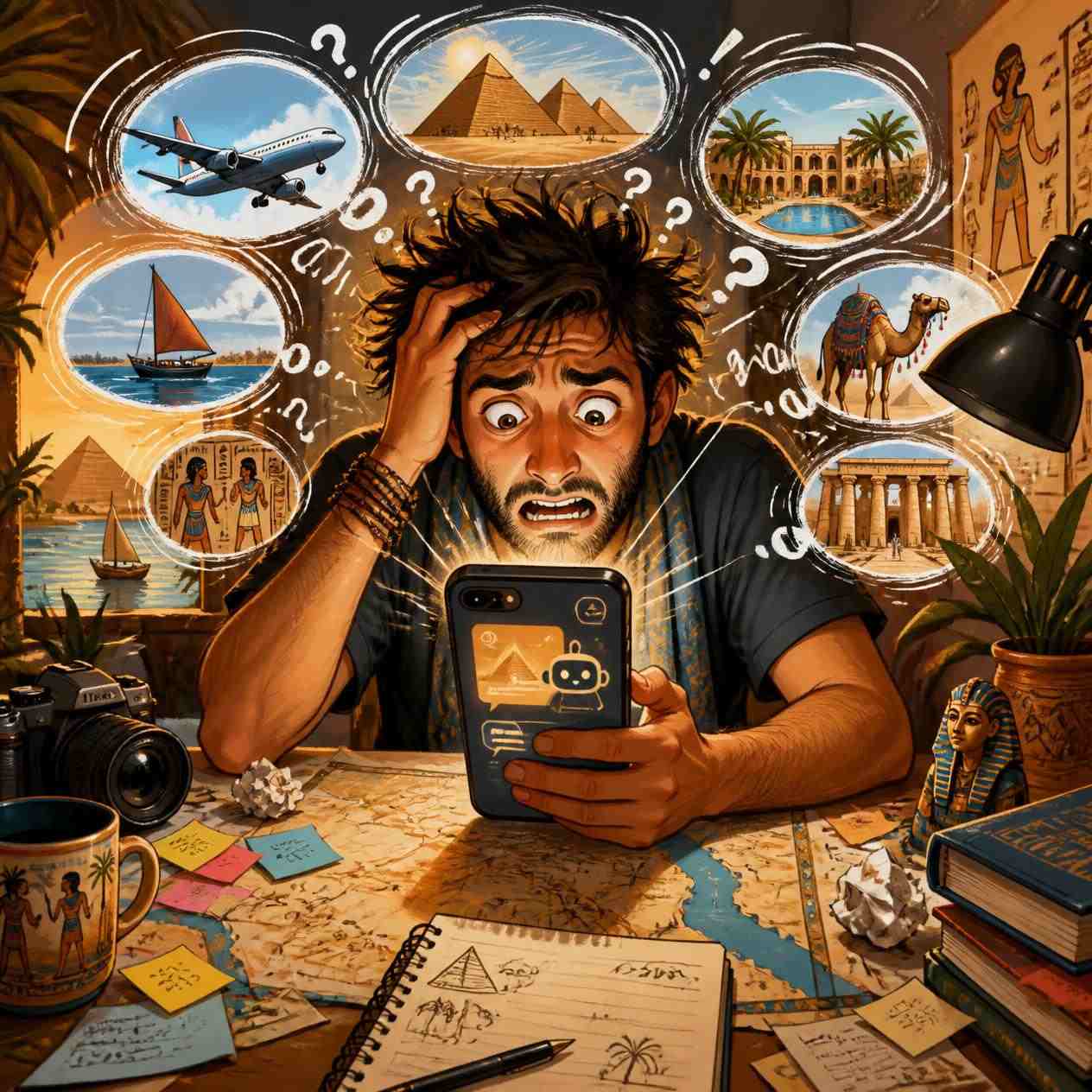
AI can be an excellent starting point for researching a trip to Egypt, but it is not a substitute for knowing how to plan one. It can suggest destinations, temples and routes, but it cannot tell you which experiences are right for you, what is missing from the information available online or when an itinerary has become too ambitious. Some of Egypt’s most interesting possibilities won’t appear in a standard search at all. A worthwhile journey takes more than collecting places to visit. It takes experience, judgement and someone who knows what lies beyond the usual itinerary.
I am writing this because I am increasingly receiving two types of email, both of which are obviously created by AI.
- The first usually arrives with an itemised, scheduled and quite frankly amazing itinerary attached, with a request for me to price it.
- The second is an AI-generated email asking me a great many questions about the 2027 Eclipse tour options in Luxor, private visits or what there is to do in Egypt during particular dates.
There is nothing wrong with using AI to ask questions. In fact, it can be extremely useful for researching monuments, finding out where the major sites are, how long it takes to travel between places, which temples are most visited and what there is to see beyond the usual attractions. You can ask it about Egyptian history, discover places you had never heard of and get answers to hundreds of questions.
But that is where I believe your dependence on AI as a trip planner should end.
AI gathers information from what is published on the internet. And while the internet is full of good information, it is also full of rubbish, outdated material and misleading opinions. AI doesn’t know the difference – that is why we see it hallucinating more and more. It hasn’t been to Egypt, it hasn’t travelled the routes and it doesn’t know what it feels like to spend several days sightseeing in the Egyptian heat. Ask it what is the best place to visit, the best tour or the best experience, and it can only draw on the information and opinions available to it. You have no way of knowing whether those opinions reflect your own interests or, indeed, your physical stamina.
The problem with an itinerary that looks perfect on screen
Ask AI for a 7, 10 or 14-day itinerary and it will usually come back with something that looks perfectly reasonable. It includes the famous attractions, suggests a route, allocates days to different destinations and produces a timetable that looks very attractive on screen. Pretty much what you might find on any major travel site, and that is where much of its initial information comes from.
The trouble starts when you ask it to dig deeper and keep adding things.
“Can we fit Abu Simbel in?”
“Yes.”
“What about Alexandria?”
“Yes.”
“And a Nile cruise?”
“Yes.”
“Could we also see the Red Sea?”
“Certainly.”
“What about a balloon ride?”
“Absolutely.”
“And perhaps another temple on the way?”
“Of course.”
Before you know it, you have an itinerary that looks fantastic on screen and would be completely exhausting in real life. In fact, the ones I receive are often so impossible that there isn’t even a sensible way to work around them. Initially I spent hours pulling them apart and trying to salvage what I could. These days, if someone is hell-bent on believing that AI has given them a workable itinerary, I just tell them right away to forget it.
AI is very good at adding. It isn’t good at saying no.
Google Maps may tell you that two places are three hours apart. An itinerary generator can happily put them on consecutive days. Neither has experienced what it is like to get up at 4.30am for the third morning running, sit in traffic, walk around an archaeological site in the heat, eat lunch in a coach restaurant and then do it all again the following day.
The information can be completely correct. The itinerary can still be a killer.
This matters particularly in Egypt because the country is much bigger than it looks on a list of attractions. Travelling between destinations takes time, and visiting archaeological sites is not always a quick in-and-out experience. Abu Simbel is a good example. It is an extraordinary place and, for some people, absolutely worth making the effort to visit. But that doesn’t automatically mean it belongs on every Egypt itinerary. If adding it means another very early start, another long journey and less time to enjoy somewhere else that matters more to you, perhaps it isn’t the right choice this time.
The same applies to Alexandria, the Red Sea, a Nile cruise or another temple that has caught your attention during your research. I am not saying don’t do these things. I am saying don’t assume that because something is wonderful, you therefore have to include it. There is no prize for seeing the largest possible number of Egyptian monuments in one visit. There is a prize for seeing the right ones for you – it’s called satisfaction.
Don’t treat Egypt like a regular item on your Bucket List
You can technically visit Karnak, Luxor Temple, the Valley of the Kings, the West Bank and Dendera in a certain number of hours. That doesn’t mean you should. Some places need time. Some need context. Others are worth seeing simply because you have arrived there and suddenly realise that what you are looking at is far more extraordinary and complex than the photograph you saw online suggested.
An itinerary also needs to make sense. The places you visit should link together in a way that gives you some understanding of what you are seeing. If the journey is disjointed, you can go home having seen a great many things but feeling frustrated because the stories never quite connected.
The first time I came to Egypt, I went home without any real, satisfying understanding of the country. I had fallen in love with Egypt – an invisible Egypt but my tourist experience was not memorable – it was all too disjointed. The stories didn’t link up or connect logically. It actually took me YEARS of my own research to work out what period followed what period. Only then did Egypt begin to make sense to me.
That is something I think is often lost when people plan a trip by collecting attractions. So many visitors can’t see beyond the Pharaohs. You may arrive expecting to spend an hour somewhere and find yourself still there two hours later because you have become fascinated by what you are seeing. You may discover that a temple you had barely heard of before the trip becomes one of your favourite places. You may want to sit somewhere for ten minutes and simply take it all in. None of that fits very neatly into an AI-generated timetable.
Which are the best sites in Cairo or Luxor?
The million-dollar question. This is one of the traps of relying on AI to plan your trip. You start with the obvious things: the Pyramids and Sphinx, perhaps the Egyptian Museum or the Grand Egyptian Museum, Luxor and the Valley of the Kings. Then you discover Saqqara. Then the Serapeum. Then Dendera. Then Abydos. Then Aswan and Abu Simbel.
What you don’t know is that the list of sites open to visitors does not end there. You don’t know because the information isn’t on the internet. I would argue that, as far as published travel information is concerned, the internet is a finite, closed information loop – not the unending stream we tend to imagine it is.
And now visitors to Egypt are increasingly caught in that loop, seeing the same handful of 14 or so sites because those are the places that appear again and again in the information available to them. I can’t buck that trend entirely, because at the end of the day most people still want to see what everyone else has seen. And then there is no day left for the unknown.
But increasingly, when people ask AI to show them something really special, something beyond the usual tourist experience, it brings them straight to me.
Specifically, to my Private Access to the Gt. Pyramid page, where I offer private visits to the Great Pyramid, the Sphinx Enclosure, the Osirion at Abydos and the Sekhmet Chapel at Karnak. I want to be honest with you about that, because it is genuinely remarkable to watch happen. AI is citing me, by name, as the person to contact for this kind of access. Not a big-name operator, not a five-star chain, but me, in Luxor, because I have built something real enough to be the answer to the question: “Who can actually get me in there?”
And those four private visits are only the tip of the iceberg. There are many more places in Egypt where private visits may be possible, although most people have no idea they exist. Some are difficult to arrange; some are expensive, and not every visit will make sense for every traveler. This is where a real conversation with someone who knows what is possible becomes important.
How do you find the Itinerary that is for You?
You tell me, broadly, what it is about Egypt that interests you. My 25 years of experience allow me to read between the lines of our conversations and understand where those interests might lead. I may suggest that you contact me before you buy your flights, for example, because changing your dates by a day or two could put you in Cairo at just the right time to join an existing group for a private visit to the Great Pyramid, without the private visit price tag.
That is what we can work out together. AI cannot even come close to that kind of personal coordination.
But here’s the catch. You discover those four private visits and your mind starts to boggle. You realise there are so many more places in Egypt you haven’t even glimpsed. Or you soldier on, and this is where AI becomes very good at helping you get into trouble. You ask it to rearrange things. What if we move this to the morning? What if we fly? What if we leave earlier? Could we do this on the way? Could we add one more night here?
It will keep working on the puzzle. Eventually you have spent so much time trying to make everything fit that you haven’t stopped to ask whether you actually have the stamina, money or inclination to rush around Egypt like a demented lunatic chasing AI’s suggestions.
The skill is not knowing what to add. It is knowing what to leave out.
So what does a good Egypt itinerary actually need?
I’m not suggesting that you shouldn’t use AI. Quite the opposite. I think it is an excellent way to start researching Egypt. Ask it questions. Get it to explain the history of a site. Ask what else there is to see around Luxor, why people visit Saqqara after seeing Giza, or what is involved in visiting Abu Simbel. Ask it to compare historical periods or explain the significance of a particular temple. It can save you an enormous amount of time and help you discover aspects of Egypt you might otherwise never have considered.
But there is a difference between researching a trip and planning one. Research gives you possibilities. Planning means making choices. AI can help you collect those possibilities, but it cannot reliably make all the decisions that will determine whether the resulting journey is right for you.
This is how I approach planning a trip to Egypt.
When someone comes to me with a certain amount of time in Egypt, I don’t start by asking, “How much can we possibly fit in?” I start with, “What do you most want to experience?”
Are you fascinated by ancient history? Are the Pyramids the reason you are coming? Are you particularly interested in Egyptian religion and mythology? Do you want to understand the stories behind the monuments or do you simply want to photograph them? Do you want to see the famous places, or are you more interested in places that most visitors never get to? Do you enjoy travelling around, or would you rather spend longer in fewer places?
Those answers make a huge difference. Then I look at the geography, travelling times, opening hours, the sites that genuinely deserve your time and the practical realities of moving around Egypt.
And then, sometimes, I tell you “No”.
Not because something isn’t worth seeing, but because it isn’t worth sacrificing something else for. That is the difference between an itinerary that looks impressive and one that actually works..
You can explore the Egypt tours I offer and you will see many of the same sites and visits that other operators offer.
Because that is what most people ask for, and there is nothing wrong with that. But if you are asking me what you can see that most visitors never get to experience, that is a very different conversation. The possibilities don’t all appear on my website. Some are private visits, some require special arrangements, and some are opportunities I can explore once I know what you are interested in and when you are coming.
My tours are not about racing around ticking off monuments. They are about making the time you have here count – and, if that is what you want, showing you an Egypt that most visitors never see.
A final word about using AI to plan your trip
This isn’t an argument against using AI. It is an excellent way to start researching Egypt. But eventually you have to stop collecting possibilities and start making decisions.
When I plan a trip to Egypt, I am not trying to see how much I can put into it. I’m trying to work out what is going to make the trip enjoyable, interesting and memorable for the particular people travelling. Sometimes that means adding something you hadn’t thought of. Sometimes it means changing the order or finding a better way to do something. And sometimes it means saying, “No. Leave that one out.”
Not because it isn’t wonderful. Because you only have so much time, energy and attention, and I would rather you came home wishing you had stayed a little longer than wishing you had done less.
AI is very good at telling you what you can do in Egypt. The harder question is knowing what you should do. That’s where I come in. AI cannot replace me.