
Last updated on 18/11/2026 by Marie Vaughan
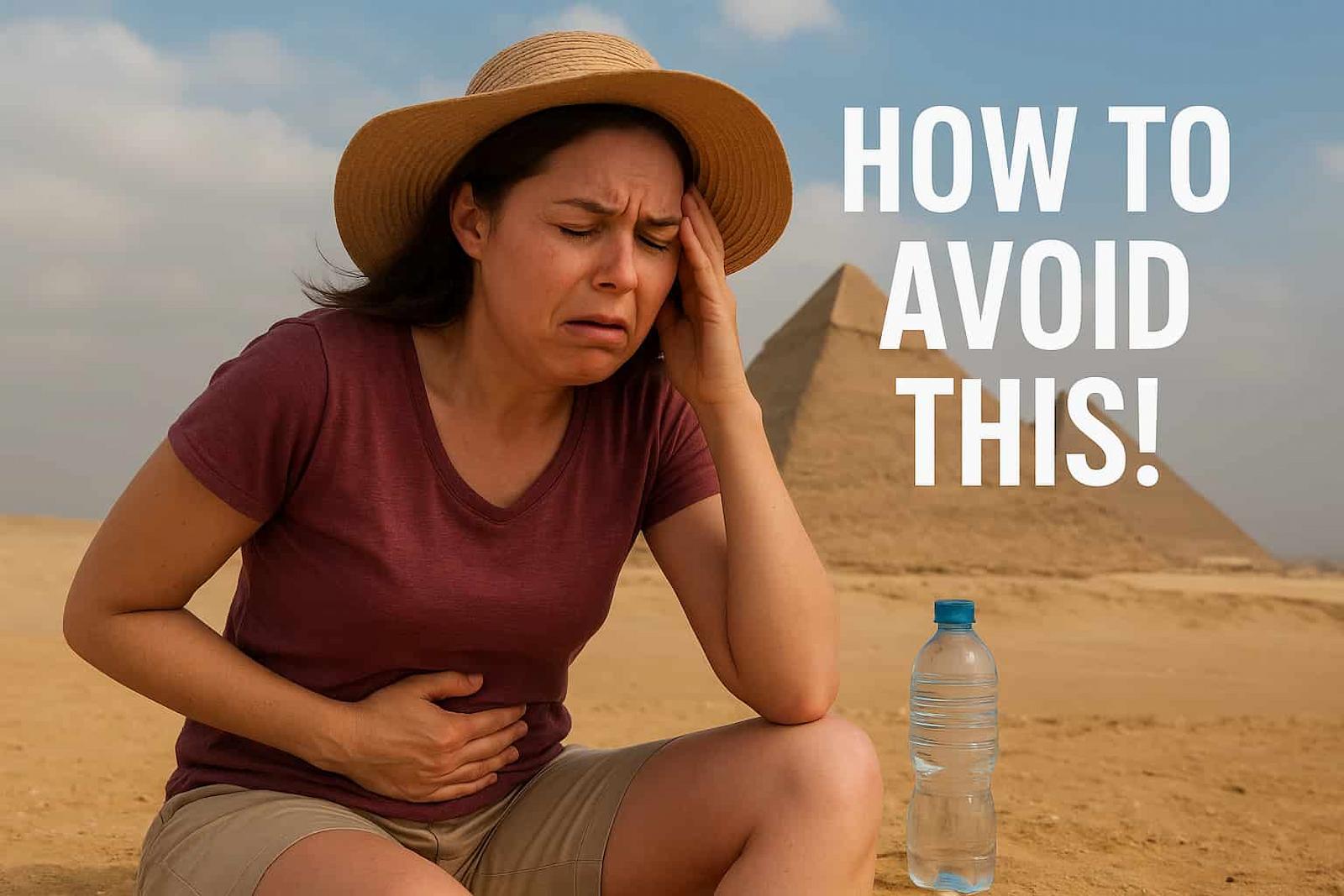
The Egyptian tummy bug can turn an otherwise excellent holiday into a miserable experience, sometimes putting you out of action for several days. But what actually causes it? Is it always something you have eaten? How do you recognise the early symptoms, and what should you do if you become ill? After more than 25 years working in Egyptian tourism, I have seen plenty of cases, including some that became very serious. Here is what I want every visitor to know before travelling, including how to recognise the symptoms quickly, what really causes the problem, why Antinal is my recommended treatment and how to avoid losing valuable holiday time.
Egyptian Tummy Bug: What Causes It and How Can You Avoid It?
If you are planning a holiday in Egypt, you have probably already read plenty of advice about avoiding stomach upsets. Much of it concentrates on food and water, and some of it is misleading. The Egyptian tummy bug is not necessarily something you catch from eating a dodgy meal. In fact, there are several everyday ways of picking up the bacteria that can make you ill, and some of them are surprisingly easy to overlook.
One thing I want to make clear is that there is a difference between an ordinary upset stomach, food poisoning, heat exhaustion and an infectious stomach illness. They can produce similar symptoms, but they do not necessarily need the same treatment.
The important thing is to recognise when something is wrong, avoid becoming dehydrated and not simply assume that everything will settle down by itself. In my experience, if you develop the Egyptian tummy bug, dealing with it promptly makes a considerable difference. Leave it too long and it can knock you out for days.
Recognising the Early Symptoms of Egyptian Tummy Bug
One of the problems with this particular illness is that you may not immediately recognise what is happening. It doesn’t always begin with an urgent dash to the bathroom. Quite often, the first indication is simply that you don’t feel right.
Watch out for:
-
Sudden tiredness or a general feeling of being ‘off’.
-
A bloated, squishy feeling in your stomach.
-
Nausea.
-
Hot and cold sweats.
-
A feeling that you are coming down with a virus.
-
No energy, even when you haven’t done very much.
-
Stomach cramps.
-
Unusual sleepiness.
-
Diarrhoea and/or vomiting.
You may experience only some of these symptoms initially. If they are developing rapidly, don’t dismiss them as ordinary holiday tiredness or something you ate the previous evening.
Six Surprising Ways You Can Catch the Egyptian Tummy Bug
People often blame the last meal they ate, but contamination can be picked up in everyday situations without you even realising it. These are six things I particularly warn visitors about:
1. Handling money. Egyptian banknotes and coins pass through many hands. You might handle money, put it away and then eat something without washing your hands.
2. Touching door handles, toilet flushes and hotel railings. Surfaces inside buildings, particularly frequently touched handles and fittings, can carry germs. Metal handrails and other surfaces exposed to strong sunlight are less likely to retain contamination in the same way.
3. Shaking hands. Everyone wants to greet you! It is lovely to be welcomed, but remember that you don’t know what the other person has touched immediately beforehand.
4. Wiping sweat from your face. This is something people do constantly in Egypt. If your hands have been handling money or touching public surfaces, you can transfer contamination to your mouth when wiping your face, licking your lips or touching your food.
5. Picking up snacks without washing your hands. That little biscuit, piece of fruit or packet of something you buy while sightseeing can be an easy way to transfer germs from your fingers to your mouth.
6. Reusing bottles without cleaning them or sharing water bottles. Bottle tops and drinking openings are easily contaminated. Don’t share drinking bottles, and make sure reusable bottles are properly washed.
7. What about that airplane you just got on/off? Regardless who your airline is – how much turn around time did it have between it’s last disembarkation and your embarkation? Whatever it was, it was not long enough for a deep clean. When was the last time it got a deep clean? Take a packet of wipes with you and before you settle into your seat give the tray, hand rests and video screen a quick wipedown – don’t forget that little knob that keep the tray in place…. and when you go to the bathroom – watch that door handle and loo flusher!
For the rest of your trip keep that small packet of hand wipes or hand sanitiser in your bag. Use them after handling money, visiting public toilets and touching frequently used surfaces, and before eating. Soap and water are preferable when your hands are visibly dirty.
Food and Water in Egypt: Two Common Myths
Myth 1: Egyptian tap water will automatically make you sick.
It isn’t accurate to label all tap water in Egypt as dangerous. If it were, then everyone would be ill all the time. Water treatment takes place here just as it does in other countries, although the chemical composition and treatment methods can differ. Some people with sensitive stomachs may find that a change in water composition upsets their digestion.
Myth 2: You must avoid all fruit and salads in Egypt.
No, you don’t need to spend your entire holiday avoiding fresh food! Reputable restaurants and hotels take care over food preparation, and I certainly don’t want visitors missing out on the wonderful fruit and vegetables available here.
However, raw produce needs to be washed properly using safe water, and you cannot assume that every restaurant, café or street vendor follows the same standards. Be sensible about where you eat, avoid food that has been sitting out in the heat and be particularly cautious about street food where you cannot see how it has been prepared. One thing about street food – you cannot see what is happening the food carts during the night.
I would much rather see you enjoying Egyptian food than living on bread and bottled water for two weeks.
For more on eating safely and enjoying the food here, I have written three other articles:
Egyptian Tummy Bug or Heat Exhaustion? How to Tell the Difference
Not every stomach upset in Egypt is an infection. I see visitors misinterpret the effects of heat, unfamiliar food and overexertion, particularly during the first few days of their holiday.
We all have different bodies, and things that one person can tolerate quite happily can leave someone else feeling distinctly uncomfortable. Here are some situations to be aware of.
Too many fizzy drinks in the heat. Excessive consumption of carbonated drinks such as Coca-Cola, Pepsi and Fanta, particularly when you are hot and dehydrated, can upset your stomach. Very sweet drinks can also make diarrhoea worse.
Icy drinks straight after being in the sun. Some people find that drinking very cold beverages while sitting in the sun, or immediately after coming back from the heat, causes stomach discomfort. If this happens to you, try waiting until you have cooled down before drinking something icy. Lukewarm water is perfectly suitable for rehydration and is often more comfortable when you are very hot. Remember that a bottle of water you have carried around in the Egyptian sunshine all day is not necessarily the best way to replenish lost fluids if you are already dehydrated.
Cold showers immediately after coming in from the sun. I have always advised visitors who are very hot to allow themselves time to cool down before jumping into a cold shower. A sudden change in temperature can be uncomfortable, particularly if you are already feeling unwell. Wait around 30 minutes or take a comfortably warm shower instead.
Too much alcohol in the heat. Drinking alcohol while spending hours in the sun is not a good combination. Cold beer doesn’t seem to have quite the same effect on some people as drinking spirits in the heat, but neither is a substitute for water. Alcohol can contribute to dehydration and make you feel considerably worse.
Overdoing your sightseeing. This is one of the most common mistakes I see. Visitors arrive in Egypt determined to see absolutely everything, and try to squeeze too many temples, tombs and activities into a very short period. The temperatures are unfamiliar, the sun is strong and the physical demands can be greater than expected.
Suddenly you feel exhausted, your stomach starts to feel uncomfortable and you want to sleep. You may convince yourself that you have contracted food poisoning or the Egyptian tummy bug, when what your body is actually telling you is that you need to stop and rest. Pay attention to that first feeling of being unwell. Don’t keep pushing yourself because you have paid for an excursion and feel obliged to complete it.
Of course, heat exhaustion is not something to ignore either. If you become very weak, dizzy, confused or faint, or cannot cool down, seek urgent medical help.
Eating unfamiliar food. Another possibility is simply that your digestive system needs time to adjust. The majority (99%) of food served in Egyptian hotels and restaurants is prepared from fresh, natural ingredients rather than the processed alternatives that some visitors are accustomed to at home. You may be eating a much wider variety of fresh produce, different spices and unfamiliar combinations.
Your stomach might need a day or two to adjust, and you may find yourself visiting the bathroom more frequently than usual. That does not automatically mean you have food poisoning or an infection.
The important distinction: if symptoms are mild and settle with rest and fluids, the cause may be something other than an infection. If diarrhoea, vomiting, cramps or general illness develop rapidly or become increasingly severe, don’t assume it is simply the heat. Seek appropriate medical advice.
Antinal: The Egyptian Medicine I Recommend for Tummy Bug
In my opinion, if you develop the Egyptian tummy bug, Antinal is the first thing you should have available. It is an Egyptian medicine, available from pharmacies throughout the country for just a few Egyptian pounds, and it has been my preferred treatment for years.
I have seen too many visitors lose valuable holiday time because they try to battle through the illness, take medication brought from home that doesn’t deal with the problem, or simply hope it will go away.
My advice is to act as soon as you recognise the symptoms rather than waiting until you are really ill. In my experience, the earlier you deal with it, the better.
-
Take 2 capsules as soon as symptoms appear.
-
Repeat every 6 hours as needed, following the medicine’s instructions and checking with a pharmacist that it is suitable for you.
-
DO NOT take Antinal as a preventative. There is no point taking it before you become ill.
Pick up Antinal as soon as you arrive in Egypt because hotels no longer routinely provide it. Don’t wait until you are feeling dreadful and then start looking for a pharmacy.
One important thing to remember is that Antinal is not a substitute for medical attention if you are seriously ill. If you have severe abdominal pain, blood in your stools, a high fever, persistent vomiting or signs of dehydration, seek medical help promptly. Replacing lost fluids and salts is also essential, and oral rehydration salts are available from Egyptian pharmacies.
Read my January 2026 update: A Critical Warning About the Egyptian Tummy Bug Before You Travel
What Happens If You Ignore the Egyptian Tummy Bug? A Real Guest Story
Some people are very reluctant to take medication. I understand that completely because I am one of them. Others believe they can simply drink enormous amounts of water and flush the bacteria out of their system.
Drinking fluids is essential, but it does not necessarily eliminate the cause of an infection. Nor should you assume that because you are still able to walk around and continue sightseeing, you are not seriously ill.
One of my biggest concerns is that people who become ill during their holiday sometimes continue travelling without getting properly better. They can become increasingly dehydrated, and an illness that might have been manageable with early attention can turn into something much more serious.
I have received emails from guests who have experienced exactly this. The following is an extract from just one email sent to me by a guest who arrived at Mara House already suffering from the tummy bug.
He had contracted it earlier in his travels and had been feeling unwell for a couple of days. However, he wasn’t so ill that he felt he needed to stay in bed, so he decided to battle through without medication. He believed that drinking plenty of water would flush the bacteria out of his system.
He continued his journey to Cairo, from where I subsequently received this email:
“By the way the stomach bug I got turned into full blown Colitis and acute Gastroenteritis. Had to get a Doctor to come to the Hotel as I lost 5kgs in a day. My blood pressure dropped and I was on the verge of collapse. They put me on a series of drips over the next 24 hrs and today I feel a lot better. On a strict diet for the next 3 days (toast, rice, clear soup). Should be right to travel to London tomorrow.”
Please do not let this be you.
This is why I keep telling visitors not to dismiss the early symptoms or simply try to soldier on. If you are ill, deal with it properly before continuing your holiday.
Egyptian Tummy Bug: What to Do and What NOT to Do
If you remember nothing else from this article, remember these points:
-
Don’t ignore the early symptoms. A sudden change in how you feel can be the first indication that something is wrong.
-
Don’t assume it was your last meal. Contaminated hands and frequently touched surfaces can also be responsible.
-
Don’t try to flush an infection out with enormous quantities of water. Replace lost fluids and salts sensibly, using oral rehydration salts when needed.
-
Don’t assume every stomach upset is the Egyptian tummy bug. Heat exhaustion, unfamiliar food and other causes can produce similar symptoms.
-
Don’t take Antinal as a preventative. There is no reason to take it before you become ill.
-
Don’t delay medical help if symptoms are severe or getting worse.
-
Do carry hand wipes or sanitiser. Particularly after handling money and before eating.
-
Do drink safe bottled water and take sensible precautions with food.
-
Do give yourself time to rest. You don’t have to see every temple in Egypt in three days!
Should You Take Antinal Home With You?
This is something I have been asked about many times. I have received emails from people who did not stay at Mara House but found my article when they became ill after returning home. Some have even asked me to post Antinal to them because they could not find it in their local pharmacy.
Unfortunately, that isn’t possible.
My advice is to take a packet of Antinal home with you if you have bought it during your stay and it is suitable for you. It is unlikely that you’ll find it readily available in your local pharmacy, and having the original packaging and instructions may be useful if you need to discuss it with a doctor.
I understand why people want to have something familiar available if they become ill on the last day of their Egyptian holiday or shortly after arriving home. However, an illness developing after travel may have a different cause and require different treatment. Don’t simply start taking medication brought back from Egypt without speaking to a doctor or pharmacist.
Enjoy Egypt Without Spending Your Holiday Worrying About Getting Sick
Listen, I have worked in tourism here since 2000. That’s over 25 years of living and working in Egypt, looking after visitors, organising their holidays and seeing what happens when things go wrong.
I see people asking for advice on Facebook groups every day, about everything from tipping to avoiding the Egyptian tummy bug. Much of the advice comes from people who have made one trip to Egypt and suddenly consider themselves experts. Some of it is useful, but a great deal of it is absolute rubbish.
If you want a happy and healthy holiday, I would suggest you think carefully about who you trust to organise it.
Forget the big tour packages where you are just another number. Let me arrange your hotels, cruise boats and dahabiyas with people I know and trust. Travel with my guides, who are interested in you and your experience, not simply getting you on and off a coach. They know where to take you for good, safe meals and will look after you personally if you need help.
I have been here since 2000, I’m a foreigner, I’m a woman, and I’ve spent more than 25 years learning how things work in Egypt. I reckon I know my stuff by now! 🙂
Listen to your gut, take sensible precautions and don’t be afraid to ask questions. You are one email away from having someone who knows Egypt looking after the details.
Contact me directly: maraegypt@gmail.com
Tummy bug. We took Mara’s advice, enjoyed some great food (salads as well) – had our hand lotion and wipes, washed hands (normal routine stuff) and we were ok. Others we met brushed their teeth in tap water on the cruise – the sign said not to – and became rather green under the gills! That would be expected from not following advice. It is all tried and tested this stuff. I carry around my box of antinal we got when we arrived, still unopened but as a fond memory.