
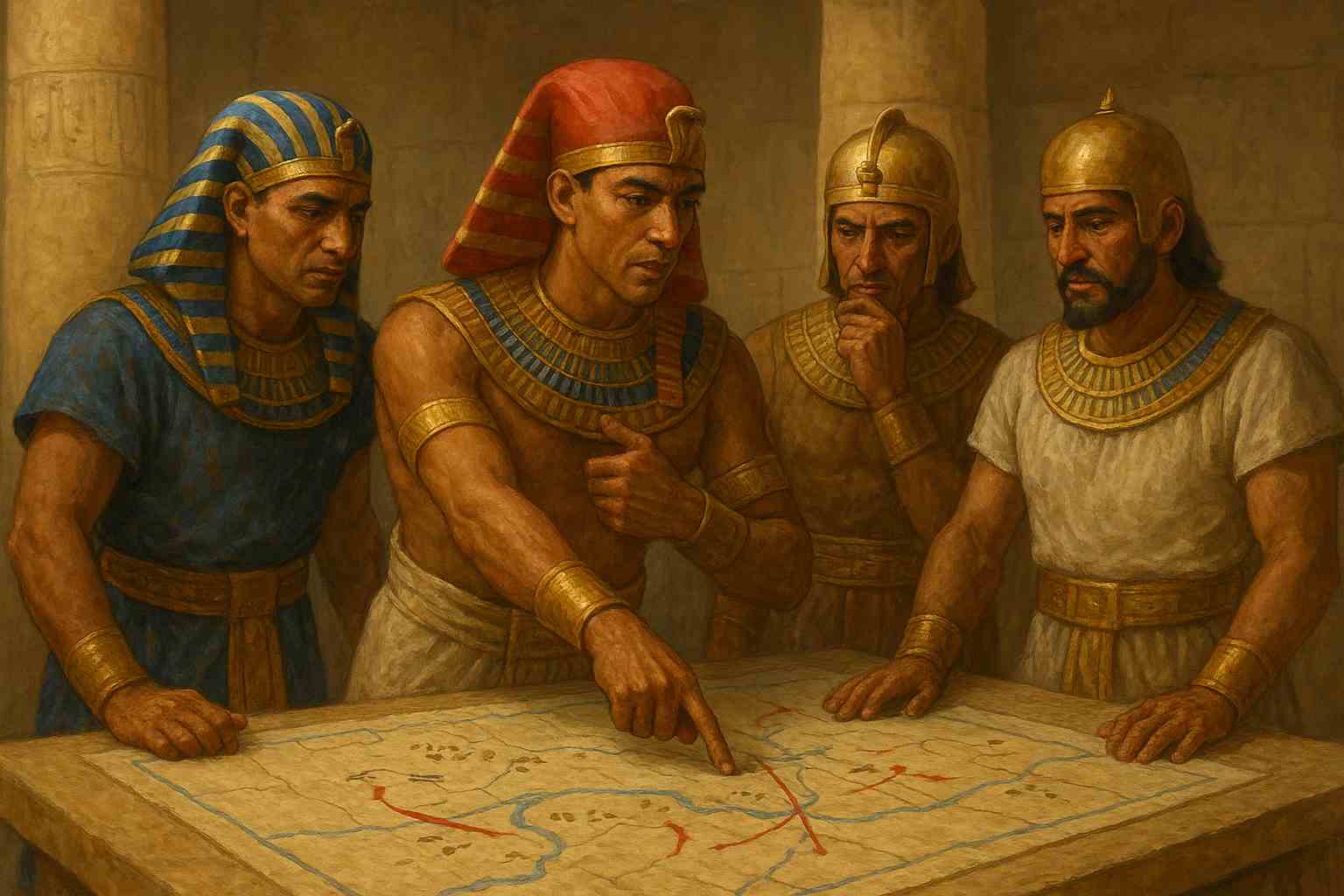
Featured image above: A dramatic recreation of the war council before the Battle of Megiddo, where the young Pharaoh Thutmose III defied his generals’ caution and chose the daring Aruna Pass route.
Before the legions of Rome, before the armies of Alexander, a single Egyptian Pharaoh faced the united might of the ancient Near East and, with one breathtaking gamble, forged an empire. This is the story of the Battle of Megiddo – a story not just of conquest, but of a king who stared into the face of convention and dared to bet his kingdom on a path no one else would take.
The Rebellion: A Kingdom at the Precipice
It is the year circa 1457 BCE. The great Pharaoh Thutmose III, newly exercising his sole power after the regency of Hatshepsut, receives a message that threatens to shatter his inheritance. A coalition of 330 Canaanite city-states and princes, led by the powerful King of Kadesh, has declared its independence. They have gathered their armies – a vast host of chariots and infantry – at the strategic fortress of Megiddo.
This is no minor border skirmish. Megiddo commands the vital trade routes of the Jezreel Valley. To lose it is to lose the artery of the empire. The message from the rebels is a direct challenge to the god-king himself. Every rival kingdom, from Mitanni to Babylon, watches from the shadows, waiting to see if the young Pharaoh will bend or break.
The Council of War: The Three Roads
Thutmose III marches his army with blistering speed to the town of Yehem, at the foothills before Megiddo. Here, he gathers his generals—seasoned, cautious men—for a war council. They lay out the options, and the tension in the tent is palpable.
There are three roads to Megiddo.
Two of them are long, looping around the Carmel Ridge. They are safe, predictable, and would allow the army to arrive in good order. The enemy expects this.
The third road is the route through the Aruna Pass.
His generals speak of it with trepidation. It is not a road for an army; it is a defile.
The Defile: The Gamble of a God-King
Imagine it not as a path, but as a crack in the world. The defile is a narrow, steep-sided gorge where the sunlight is choked by overhanging rock. The passage is so tight that men must march in single file. A chariot would scrape its wheels on both sides. The line of an entire army would be stretched out, vulnerable and helpless, for miles.
To enter the defile is to offer your throat to the enemy. If the King of Kadesh has posted even a handful of archers on the cliffs above, they could rain down death. The campaign would end before it began, the army trapped and slaughtered in a rocky grave. His generals beg him, plead with him, to take the safe route.
Thutmose III’s response is etched into history: “I will march on this road of Aruna! Let him who will among you, go upon those roads you have mentioned, and let him who will among you, come in the following of my majesty!”
The army follows its god-king into the narrow, dark defile. Hearts pound. Every echo of a dislodged stone sounds like an ambush. For a day, they are at their most vulnerable, their destiny hanging on their Pharaoh’s gamble.
The Victory and The Failure: Ropes and Robes
The gamble pays off. T hutmose’s intuition was divine. The Aruna pass is undefended. The Egyptian army emerges onto the plain of Esdraelon, unscathed and positioned perfectly between the enemy and their fortress. The coalition, caught completely by surprise, is forced to scramble and meet them in battle.
The next morning, Thutmose III, shining like the god Ra, leads the charge. The Egyptian army, inspired and ferocious, smashes the disorganized enemy lines. The coalition breaks. It is not a retreat; it is a rout. A blind, chaotic, desperate flight for the safety of Megiddo’s towering walls.
And here, the story reveals a scene of stunning human drama.
A panicked mob of princes, charioteers, and soldiers reaches the gates of Megiddo. But the city guards, seeing the Egyptian forces in hot pursuit, make a cold, calculated decision. They slam the massive gates shut. To open them is to let the enemy in. The defeated army are trapped outside with their conquerors.
From the top of the walls, the people of Megiddo throw down ropes. But there is no time for niceties. There are no baskets or ladders. In a moment of pure, undignified desperation, the finely-robed princes and armored soldiers below wrap the ropes around their own tunics, their sashes, their rich robes. The men on the walls above then begin to haul them up, hand-over-fist, by their clothing.
Visualize the scene: A Syrian prince, his embroidered linen tearing under his weight, scrambling against the sun-baked brick. A Canaanite general, dangling in his own armor, being dragged to safety like a sack of grain. It is a complete collapse of order, a total humiliation.
And for Thutmose III, it is a moment of profound frustration. His own soldiers, seeing the enemy in this helpless, suspended state, stop to plunder their abandoned camp. His fury is recorded in the campaign records: “Then his majesty was vexed at them… Now if only the army of his majesty had not given their heart to plundering the belongings of the enemy, they would have captured Megiddo at this moment… for the ruler of Megiddo was being pulled up, hauling him by his garments, to set him into the town.”
Had they pressed the attack, they could have taken the city in that very moment, capturing the rebellious kings as they dangled from the walls. “The capture of Megiddo is the capture of a thousand towns!” the Pharaoh laments. In his greatest victory, he saw the shadow of a greater one that got away.
The Echo of Megiddo
Thutmose III would lay siege to Megiddo and take it. He would go on to fight seventeen more campaigns without a single loss, building the largest empire Egypt had ever known. But it all began here, in the defile and before the walls.
The story of Megiddo is the ultimate lesson for those who command destinies. It teaches that the path to legendary victory is often the one everyone else is too afraid to take. It reveals that moments of supreme opportunity are often brief, messy, and require the clarity to see through the chaos.
Thutmose III saw his omen in the stars and in the geography of risk. He took the narrow gate, and walked into eternity.
The question always is … not what the safe path holds. The question is, does fear hold you back and what awaits you on the other side of the defile?
Last updated on 21/06/2026 by Marie Vaughan