Ramses II: From Ozymandias to Abu Simbel’s Sun Miracle

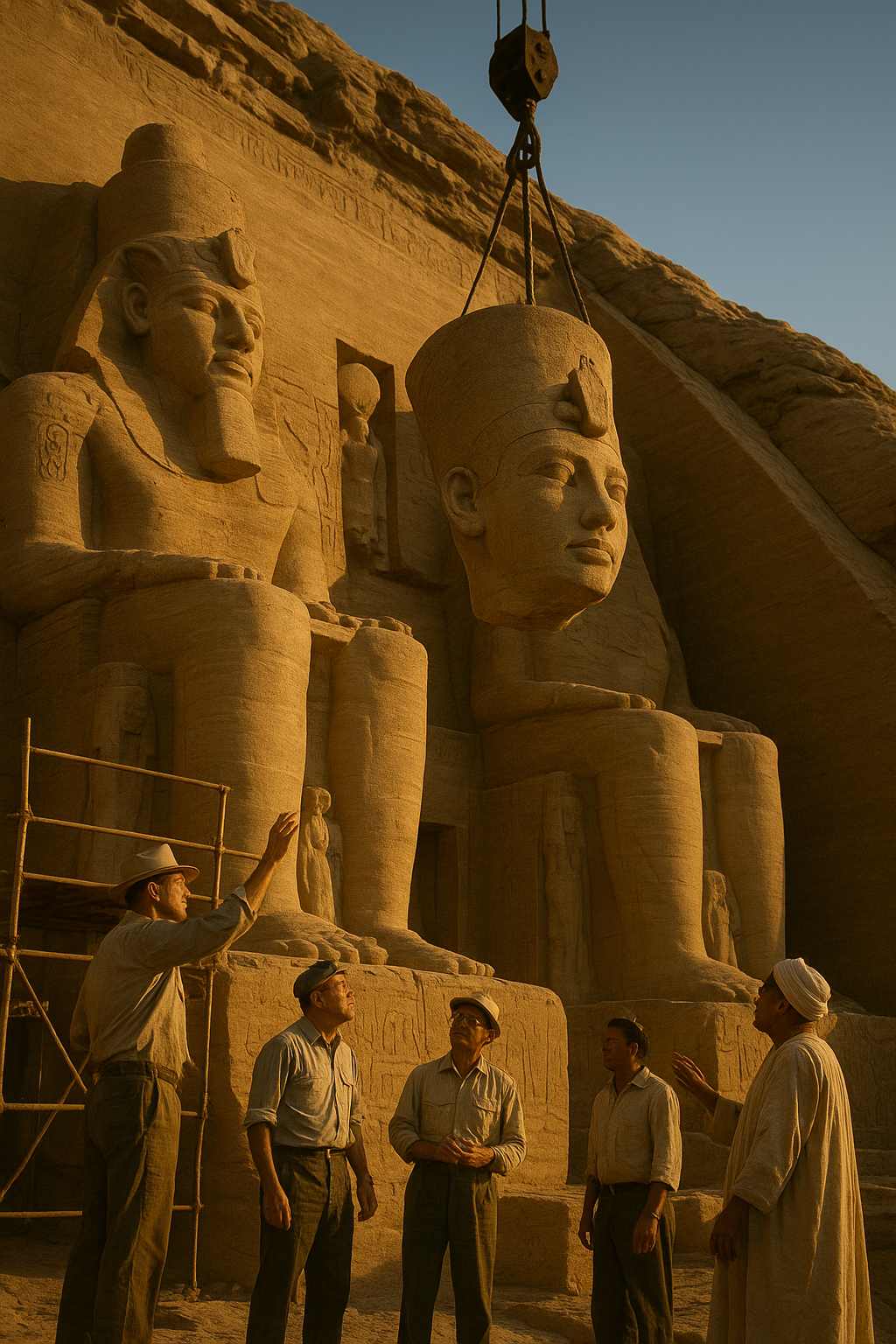
Mid-1960s scene at Abu Simbel during the temple relocation: international engineers and Egyptian workers stand on scaffolding, discussing as a massive stone head of Queen Nefertari is suspended by a crane above her seated statue. Colossal statues of Ramses II are in the background under warm golden-hour desert light

Featured Image aboveEngineers and workers carefully moving Queen Nefertari’s head at Abu Simbel during the 1960s temple relocation.

He loved her like a god — carving her face into temples, aligning the sun to kiss their statues, and ensuring her gaze never left him.

Ramses II was now a god-king walking in a shadow of his own making.

He had ridden out from Tjaru and fought the Hittites to a stalemate at Kadesh and spun it into a masterpiece of propaganda.  He commanded two versions of the event to be carved in stone: a thrilling, first-person Poem that cast him as a lone hero saved by the god Amun, and an official Bulletin that presented the story as military fact.  Together, they were a potent magic, designed to convince both the heart and the mind for all eternity., carving his “victory” on every temple from Abu Simbel to the Ramesseum.

Part I of this story is here Ramses II & Nefertari: Legacy, Love, and the Pharaoh Who Carved for Eternity

He had signed a lasting peace treaty, marrying a Hittite princess, Maathorneferure, in a move of political genius that secured his borders.

He had built and built and built: the completed Hypostyle Hall at Karnak, where his deeper, more prominent cartouches overshadowed his father’s finer work; the Ramesseum, his vast mortuary temple where a colossal statue of him, now known as Ozymandias, would one day lie shattered; his additions at Luxor Temple and he had completed his father’s monument to Osiris, the Temple at Abydos, where, as a boy, he had watched his father’s discussions with architects and craftsmen, pouring for endless hours over papyrus drawings with artists, commissioning the building of the seven chapels and the second court.

Ramses had finished his father’s grand design by placing him among the gods and declaring for all to see how beloved of the gods, Seti had been – anointed and blessed for all eternity by Horus and Thoth – gods of courage, strength and wisdom.

Years turned into decades.  He outlived Nefertari by over forty years.  He outlived his beloved mother, Tuya, for whom he built a chapel at the Ramesseum.  He outlived his crown prince, Amunherkhepeshef, and many other children.  His long reign was one of stability and unmatched glory, but it was also a long, slow procession of loss.

He finally passed the crown to his thirteenth son, Merneptah, a man in his sixties, seasoned and steady, who would soon face invasions that would have broken a lesser king.

Walk through his temples today.  Feel the sun where his likeness once stared out.  You are not walking among ruins.  You are walking inside the mind of a king.  Run your fingers over the hieroglyphs at Abu Simbel or Karnak or Abydos.  Feel the depth of his cartouches, carved deeper than any pharaoh’s before or since.  It was a literal, physical act of ensuring his name—his very essence—would not be erased by time.  Know that his fingers touched every stone because you can be sure his essence is in the stones.  You are reading a story he desperately wanted you to believe.  A story of battle, love, divinity, and power.  It is a magnificent story, gripping and grand.

And it is a powerful reminder that history is rarely a simple record of what happened.  It is often the breathtaking, enduring, and utterly human art of what someone needed us to remember.

Through it all, he never stopped building his gift to Nefertari.  Abu Simbel was completed.  And twice a year, the sun performed its miracle, piercing the inner sanctum to illuminate the statues of the gods and the god-king himself.  But just across the way, Nefertari’s temple stood, her stone gaze forever fixed on his, bathed in the same Nubian sun.  It was his public vow, made eternal: Where you find me, you will find her.

His own tomb, KV7 in the Valley of the Kings, was a cosmological machine.  Its walls, covered with the Book of Gates and the Amduat, were not stories to read but journeys to magically undertake.  He would merge with the sun god Ra himself, traveling through the night to be reborn at dawn.  But on the wall of Nefertari’s tomb, he had ensured the presence of the god Shu, the god of air and light, the space between earth and sky.  It was a final, magical prayer: that Shu would provide the breath, the light, the pathway for their souls to find each other in the vastness of the afterlife.

The Modern Whisper: The Vision Made Real

Centuries turned to millennia.  Sand and silence covered the temples.  The head of the great colossus at the Ramesseum broke off and lay in the dust, inspiring Shelley’s poem of hubris fallen.

Then, in the 1960s, the world awoke to a new threat. The rising waters of the Nile, tamed by the Aswan High Dam, would swallow Abu Simbel forever.

An international team of engineers performed a miracle.  They sawed the entire mountain into over a thousand blocks, a dizzying puzzle of stone.  They moved it, piece by piece, up an artificial cliff, to reassemble it.

But during the reassembly of Nefertari’s temple, a problem arose.  The head of one of her colossal statues refused to sit right.  It was unstable, stubborn.  The engineers, all logic, mathematics, and laser levels, were baffled.  Days were lost.  The project manager, a pragmatic man named Ahmed, felt the pressure from Cairo.

A young Egyptian archaeologist, who had spent his life studying the two figures, whispered, “Perhaps she is looking the wrong way. She needs to see him.”

Ahmed scoffed. “Don’t be sentimental.  It’s a matter of weight distribution, not love.”
But the problem persisted.

Frustration peaked.  The chief engineer, a gruff and brilliant Italian named Egitto Croci, had had enough.  He threw his clipboard down.  “Basta!  Enough!  We’ve tried everything by the book. Maybe the romantic fool is right.  She’s not looking at him!”

He barked an order. “Ignore the plan!  Shift the block!  Turn her head until she is looking directly at his temple.  Let’s see if the great lady approves!”

The crew, skeptical but obedient, used their cranes and jacks to slowly, carefully, pivot the multi-ton stone head.  It turned, millimeter by millimeter, until the majestic, stone-eyed gaze of Queen Nefertari was fixed perfectly, eternally, across the plaza towards the great temple of Ramesses II.

They stepped back. They checked the instruments.  It was perfectly balanced.  It settled into place as it had always been meant to be.

A hush fell over the crew.  Egitto Croci picked up his clipboard, shaking his head in wonder. “Ecco. There you are, my queen.  Now you can watch over your king.”

It is a legend handed down.  It might not be fact.  But in Egypt, some stories are truer than history.

It tells us that their Heka—their magic of intention made stone—was so powerful it reached across three thousand years.  That even modern engineers, in their desperation, became unwitting priests in their cult, fulfilling the Pharaoh’s deepest desire.

When you go to Egypt, don’t just see the ruins.

  • At Abydos, see the young prince, treading the Kings List under the watchful eye of his father, roping and taming the bull, desperate to be worthy of his father’s overwhelming legacy.

  • At the Ramesseum, see the fallen colossus not as a symbol of failure, but as a testament to a passion so immense that even its broken pieces awe us.

  • In Nefertari’s tomb (QV66), feel the quiet, intimate magic—the greatest act of love a god-king could conceive: ensuring the woman he loved, made it through the gates to eternity and became a goddess beside him.

  • And at Abu Simbel, in the piercing morning light, see more than the ego of Ramesses. See the love story.  Feel the Heka,  and you become part of their magic.  Stand in the smaller temple and look at Nefertari’s face.  She is not a minor consort; she is a cornerstone of a king’s heart and a nation’s soul.

They believed that to speak a thing was to give it life.  To carve a thing in stone was to make it eternal.  They carved their love, their hope, their desire for connection, into the very skin of the world.  The sand tried to bury them.  But they built, and they loved, too big to ever be forgotten.  And in looking at it, in being awed by it, you become part of their magic—you are helping to remember them, and in doing so, you are helping their greatest wish, their most powerful spell, finally come true.

And that is why I write not only their memorial stories but also the stories of my own ancestors.

Last updated on 20/12/2025 by Marie Vaughan