
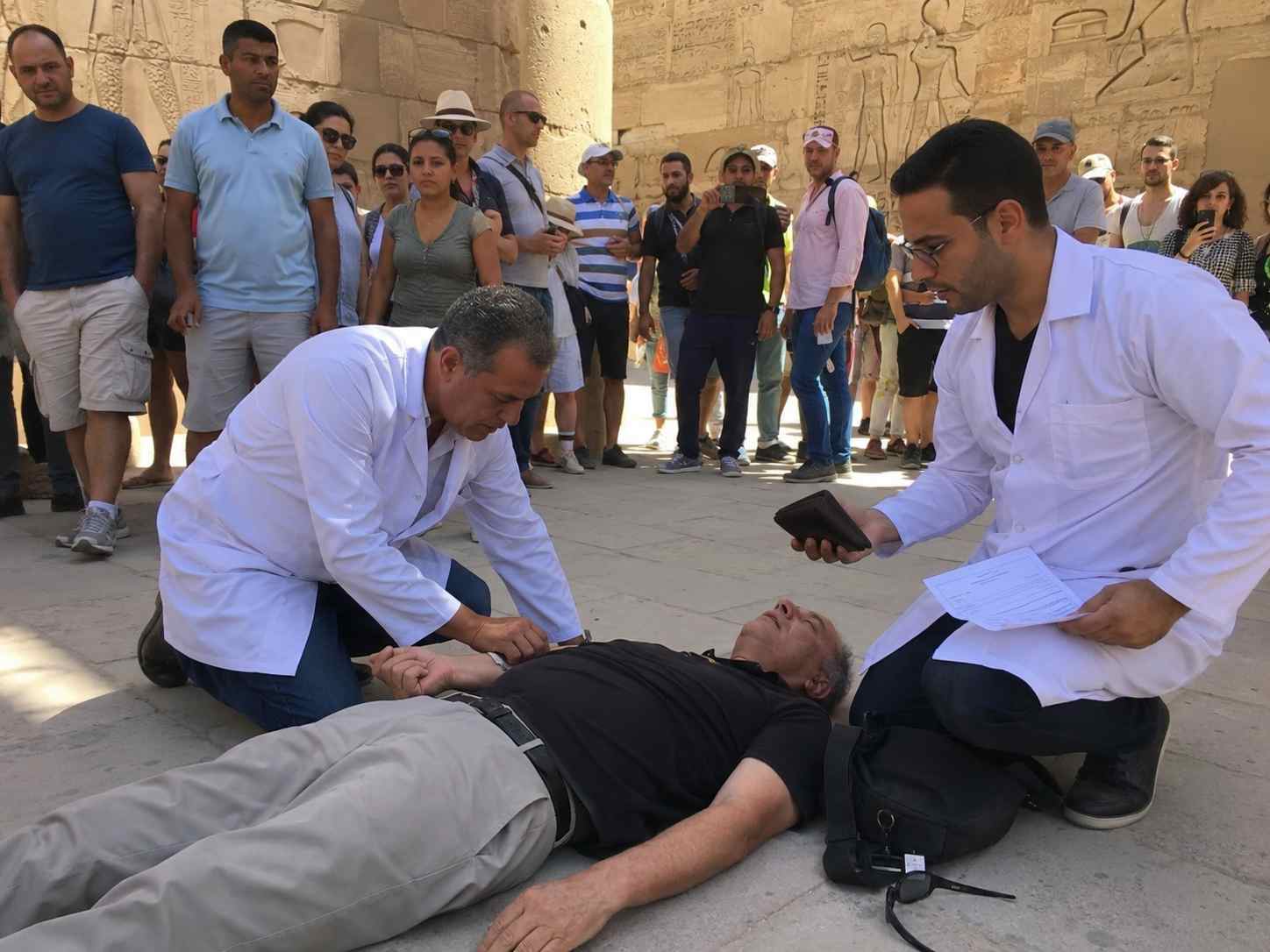
Over my years of running Mara House Luxor and leading tours throughout Egypt, I have encountered more occasions than you might expect where a guest’s medical history became suddenly and urgently relevant. An insect bite. A cat scratch requiring assessment for rabies risk. A balloon accident.
More than one guest arriving at Mara House already suffering from an Egyptian stomach bug, but unable to take the standard local remedy Antinal – either because their existing medical condition prevented the medicine from fully taking effect, or because they thought it would just “wash out”. And several cases of guests whose blood pressure dropped lower than was safe, for reasons they hadn’t anticipated.
Thankfully, every single one of those incidents resolved successfully – and in each case the person involved was conscious and able to communicate their medical details to the doctors themselves.
But what if they hadn’t been?
What if the insect bite had caused a more severe reaction? What if the balloon accident had left someone unconscious? What if someone on blood thinning medication was in an accident, bleeding, unconscious and nobody is thinking – blood thinner? These aren’t dramatic hypotheticals – they are real situations that real travelers face, and the margin between a good outcome and a very serious one can come down to whether the right information was available at the right moment.
It takes five minutes to prepare. Here’s what to do – and why it matters.
You May Not Be Able to Speak for Yourself
Whether it’s an accident, a sudden illness, or a reaction to something unexpected, there may be situations where you simply cannot communicate. The most natural thing any attending medical professional will do is search your bag for medication and information. Make it easy for them.
Egypt has excellent doctors and hospital staff, and medical professionals will have no difficulty reading standard English medical terminology, drug names, and dosages. Where a written record matters most is speed. In an emergency, nobody has time to piece together your medical history from scattered pill packets and guesswork.
The Hibiscus Tea You Didn’t Know Could Affect You
🌺 Did you know? Hibiscus tea – known locally as karkadeh – is the most powerful natural substance known to lower blood pressure? It is also the most commonly offered “welcome drink” across hotels, restaurants, and tourist sites throughout Egypt, and it is delicious.
If you are on medication for high blood pressure and drink karkadeh generously over several days in succession, your blood pressure could drop to dangerous levels. This is exactly the kind of interaction that a written medical record can flag before it becomes a crisis if the information is at hand.
You will be offered free welcome drinks everywhere you go in Egypt. Knowing what’s in your glass – and how it interacts with what’s in your body – is genuinely important.
Medications Have Different Names Abroad
The brand name of your medication at home may mean nothing in Egypt. Drug brands vary significantly between countries, and in an emergency there is no time to research equivalents. Always record the generic or chemical name of any medication you take, alongside the dosage. This is the universal language that medical staff everywhere will recognise immediately.
Heat, Dehydration, and Your Medication
Egypt’s climate is extreme, particularly between April and October. Certain medications – including diuretics, lithium, and some heart and blood pressure drugs – interact dangerously with heat and dehydration. A written record that flags this means attending staff can factor it in from the very first moment, rather than discovering it later.
Your Phone Can Help Too
iPhones come with a built-in Health app (the white icon with a small red heart) that includes a Medical ID feature. Critically, this can be accessed from the lock screen without a password – and awareness of this among medical personnel is growing. It is absolutely worth filling in.
📱 To set up your iPhone Medical ID: Follow Apple’s guide here
Android and Samsung users can download equivalent apps – though awareness of these among medical staff is less consistent, so a written backup remains the safest option regardless of what phone you carry.
What to Put in Your Written Record
Keep a printed or handwritten copy of the following in your bag – ideally in a clear plastic sleeve so it’s easy to spot:
| 📋 Medical Record Checklist | |
|---|---|
| Hotel name and phone number | |
| Full name | |
| Date of birth | |
| Blood type | |
| Current medications | Include generic/chemical name and dosage |
| Known allergies | Medications, food, environmental |
| Existing medical conditions | |
| Your doctor’s name and contact | Home country |
| Emergency contact | Name, relationship, phone number |
| Travel insurance provider | Policy number and emergency helpline |
Due to data protection policies, no hotel will ask for this kind of information from their guests. But I like to be prepared for all eventualities – I usually ask my guests in advance to let me know of any allergies, conditions, or situations I should be aware of, and if they are comfortable sharing that with me. I always have doctors ready to attend to my guests at Mara House in any situation that may arise. Ultimately it is the responsibility of every individual traveler to be as prepared as possible for the unexpected – but isn’t it comforting to know that your tour managers, guides, and accommodation providers are equally prepared.
Some might read this post and think I am being an alarmist – I am not. I simply prefer to prepare for all eventualities and emergencies. Most trips to Egypt are completely trouble-free, and you will almost certainly never need any of the advice I have given here. But slipping a piece of paper into your bag before you travel is one of the smallest, simplest things you can do – and on the rare occasion it’s needed, it could make all the difference.
Last updated on 22/06/2026 by Marie Vaughan