
This is not the basic advice giving article you might expect – this is knowledge given in plain English.
I updated this article on 17 May 2026 and apologise that it rambles in places but tipping in Egypt is the number one source of annoyance to tourists. Understanding it requires a willingness on the part of the traveler to get as much truthful background on the subject as possible. I am not always the best at explaining so please bear with me.
TOP TIP – that nobody will tell you – You want the best service and attention? Tip generously BEFORE you get the service, the moment the person attending to you meets you, and the service will reflect the value of the tip – whether it is a guide, in a restaurant, hotel housekeeping, concierge or coffee-shop. The person receiving the tip may be surprised (but push the tip with a smile) because only people in high-society know to do this.
Table of Contents
- The Economic Context
- A Necessary Update on Tipping Figures
- Tipping vs. Baksheesh
- Alternative Tipping Recommendations You Might Have Encountered
- How to Tip Someone and What Not To Do
- Tipping: A Source of Frustration
- Currency to Use for Tipping
- Exceptions to Tipping: When It’s Not Required
- Conclusion
Tipping: A Source of Frustration
Tipping drives many tourists crazy – especially those on tight budgets. As a foreigner living here, I can probably say more directly what many Egyptians feel uncomfortable saying.
That word – “should” – comes from a time when foreign currency stretched much further in Egypt and the economic gap was very different. Those days are gone. The cost of living here is now as much of a struggle, as it is in many visitors’ home countries.
So, if you want stop with the mental gymnastics of converting currencies in your head and trying to hold in your mind what you saw on facebook – here is an easy and personal way to evaluate your tip – “what tip would satisfy me if I just delivered this particular service?”
The importance of a minute
The one thing we constantly forget – about our own lives and the lives of everyone around us – is that life is really measured in minutes. Limited minutes.
Your life. My life. Everyone’s.
Every time someone waits for us, helps us, drives us, cooks for us, carries our bags, or solves a problem for us, they are giving us some of those minutes – part of their limited life.
Apply that to yourself for a moment. Your work. Your exhaustion. Your time. Your life.
Then ask yourself: what is a tip really worth – what is the life value of someone’s minute? Not just in Egypt, but anywhere?
The best honest advice on tipping in Egypt can be summed up in 3 sentences:
- A $5 tip in Egypt has exactly the same value as a $5 tip in the US, no more and no less.
- You can tip in any foreign currency notes but foreign coins are no good.
- You can tip in Egyptian money – it is all money.
Personal Impact of Tipping
Remember, we are all human beings with emotions. When I inform staff members that they have received praise in a good review – whether it’s at Mara House, on a cruise boat, or during a tour – their gratitude is palpable. After all, isn’t it essential for everyone to feel valued and appreciated? Tipping is an expressions of personal appreciation.
Not tipping a person in Egypt can have a demoralizing effect. It’s not only about the financial aspect; it’s about acknowledging their effort and making them feel that their work has made a positive impact on your experience.
The Culture
Tipping is culturally embedded and expected by Egyptians from Egyptians. It played a critical role during the economically tough years from 2011 to 2017, acting as a form of mutual aid without loss of dignity.
- Egyptians tip with gratitude and grace, or not at all if there’s a valid reason like discourtesy.
- Tipping or not tipping signals to workers whether they performed well.
- The Egyptian economy has faced several challenges, including the devaluation of the Egyptian pound and removal of government subsidies, increasing the cost of living. Tipping helps supplement wages which cannot keep up with the cost of living.
The Economic Context
- Even government employees such as teachers and clerks take on additional jobs outside their main employment.
- Devaluation of the Egyptian pound in 2016 and subsequent devaluations since 2022 and ongoing in 2026 have severely impacted purchasing power.
- Removal of subsidies increased the cost of basic necessities.
- Tourism industry struggles: operators often quote prices below costs, resulting in hidden extras and reliance on tipping to supplement wages.
- I know this is horrible and ridiculous for you to hear – but it is not unknown for guides to have to pay the tour company to get the guiding job not the other way around – and if you are smart you will realise what that means.
To put money into context:
- 1 kilo of GOOD meat is over 1000 le per kilo – that is US$19. Few Egyptians eat meat every day.
- 1 kilo of apples is 200 le – $4
- things like rice, pasta etc are the same as abroad.
- 24 disposable baby nappies is around 1000le depending on brand = $18
- electricity for average family is 2250 le per month = $48
Tipping vs. Baksheesh
It’s important to distinguish between tipping and baksheesh.
- Tipping: This is for services rendered. You give a tip to show your appreciation for good service, whether it’s to a waiter, hotel staff, or tour guide.
- Baksheesh: This term can sometimes be used interchangeably with tipping but traditionally refers to giving money without a service being rendered, often resembling begging. It’s important to recognize individuals who genuinely provide a service versus those who ask for money without offering one.
A Necessary Update on Tipping Figures
When I first wrote this article many years ago, many of my readers were budget travelers trying to make Egypt possible on tight margins. The figures I suggested then were realistic within that context.
If you are traveling with me now, you are not doing Egypt on a shoestring. You are investing in depth, access, professionalism, and experience. The people serving you are not casual workers – they are experienced professionals carrying significant responsibility for your comfort, safety, and insight.
Tip in a way that reflects the standard of travel you have chosen – and the standard of service you have received.
— If you are investing in a meaningful journey, let your tipping reflect that same level of meaning.
style=”text-align: center;”>GENERAL TIPPING GUIDELINES
For Those Who Must Have a Starting Point in Cash Figures:
These are not my tipping recommendations – they are my recommended starting points when thinking how much you are expected to tip. They are minimum guidelines.
- Tour Guides and Drivers: Tip guides minimum US$30 (1600 Egyptian pounds) per day and drivers around half that amount.
- Hotels: For porters, it’s customary to give around US$2 = 120 Egyptian pounds per bag. Housekeepers should receive at minimum US$10 = 550 Egyptian pounds per day.
- Cruise Boats: End of Stay Tipping on Cruise Boats and Hotel. Most have a tip box in reception for the staff you don’t meet, such as laundry staff, kitchen staff, and general workers. The minimum expected tip would be $20 = 1065 Egyptian per couple per night. That tip is expected to be given by all my guests that I book tours for. Managers are not generally included in the tip box, so if you have had regular contact with a manager of some sort, who was extra helpful to you, a tip may be in order, depending on how much you have had to do with him or her. The same goes if you had a particular waiter who was very attentive to your needs. Discretion when tipping waiting staff on the boat is important. You need to specify the tip is directly for him and not a general tip for the kitchen. Sometimes there are chefs who are particularly proud of the food they have prepared for you, and you will notice that these will have been keeping an eye on your reaction to their food during the trip. If you are feeling generous, you could make it a point of complimenting them and giving a tip also.
- Felluca Captains and/or their helpers: US$10 = 550 egyptian pounds.
- Taxis: US$5 = 275 egyptian pounds but that is a difficult one because you should not get into a taxi without agreeing the rate before you get in. The tip is extra if he waited around for you or is particularly helpful.
- Shops and Markets: If a salesperson or stall keeper helps you extensively, it’s polite to leave a tip as a token of appreciation
- Toilet Attendants: US$2 or 120 egyptian pounds. If you are in Egypt and wondering why toilet paper is not supplied in bathrooms outside of hotels and airports – here is a raw detail – sewer pipes are narrow, continually getting blocked from the volume of paper used by tourists. So, attendants hand it out – but you are free to ask for more. They use water and don’t understand what you are doing! Plus they have to buy the toilet paper out of the tip you give them. Heaven protect us from the amount of whining on social media about this, when people could just go find out why!
ON RESTAURANTS: If you are eating in a top hotel restaurant and the meal costs you upwards of $50 leaving a 10% tip means you are leaving the waiter $5 – don’t expect a smile because they are accustomed to much more. If you are eating in a normal type Egyptian restaurant and the meal costs you 1000 LE leaving a 10% tip = $2. If that is what you tip your waiter at home, then I guess that’s fine. But suppose you were the waiter? Tip directly to your server. While some restaurants may include a service charge, it doesn’t always go to the staff. Therefore, it is still appreciated if you leave a tip directly.
Alternative Tipping Recommendations You Might Have Encountered
Facebook Advice
There are two types of responders to questions on facebook groups abour Egypt and they usually fall into two categories –
- The first group is made up of a few foreigners like myself who know the realities, traveled, properly researched, and had a good time, so we are happy to help. We will give explanations as to why things are the way they are, to promote cultural understanding. Regarding tipping we will explain the economy.
- The second group – They are mainly Egyptian and they are there touting for business. Unfortunately, they think the quickest way to win over foreigners is to agree with every complaint, apologise for their fellow countrymen and the government, then offer friendship and “help” to anyone planning a trip to Egypt. RUN AWAY! They will condemn tipping and tell you tip small, because you want to hear that. Some foreigners are innocent enough to build personal correspondences online with these scavengers, employ them as personal guides, and one way or another will end up sending them money to fix every sad situation poured into their ears.
Questionable Tipping Guidance: Online advice from Tour Operators
I’ve encountered certain tour operators, often those masquerading as genuine local experts, offering misguided advice on tipping, some even boldly advising against tipping altogether. Some of these operators, who vehemently reject tipping and claim to include it within their prices, may be using this as a tactic to win your business. It’s crucial to scrutinize what they’re truly offering in return for your business. These operators are aware of the frustration tourists often feel about tipping and exploit this sentiment, assuring you that tipping is unnecessary and relieving you of the emotional and mental burden associated with it. Instead, they should aim to help you grasp foreign customs in unfamiliar territory and guide you on making a positive impression on the locals. After all, every tourist serves as an ambassador for their home country while abroad.
Questioning the Credibility of Some Travel Bloggers on Tipping
I find some travel bloggers’ advice on not tipping or suggesting minimal tips frustrating. It’s evident they receive complimentary accommodations, along with commissions from various sources, in exchange for promoting places, operators, products, etc. They enjoy a few luxurious days in a country with everything provided, and suddenly, they present themselves as experts without a genuine understanding of the local economy or cultural customs. It is unlikely they even hit the streets themselves.
Why Not Include Tipping in the Pricing?
I understand that some guests would prefer if tipping was included in the pricing. Every year, when reviewing my own tour prices, I am tempted to include the tipping in my group tours, as I cringe inside any time I or my guides have to remind people to tip the bus driver, a cruise boat, or a waiter. I also feel very embarrassed if guests at Mara House ask me the appropriate amount to tip my housekeepers or Amr for cooking up his amazing Salahadeen Feast. However, altering the economic landscape of a country that isn’t mine isn’t a viable solution. Instead, my aim is to help you navigate and appreciate the local tipping culture.
If you don’t personally offer tips, the workers may interpret it as a sign that you didn’t find their service worthy of a tip, which could leave them feeling disheartened. It’s essential to recognize that tipping isn’t merely a financial transaction; it’s a culturally ingrained way of expressing gratitude throughout Egypt. It’s a tradition that extends beyond individual preferences.
How to Tip Someone and what not to do
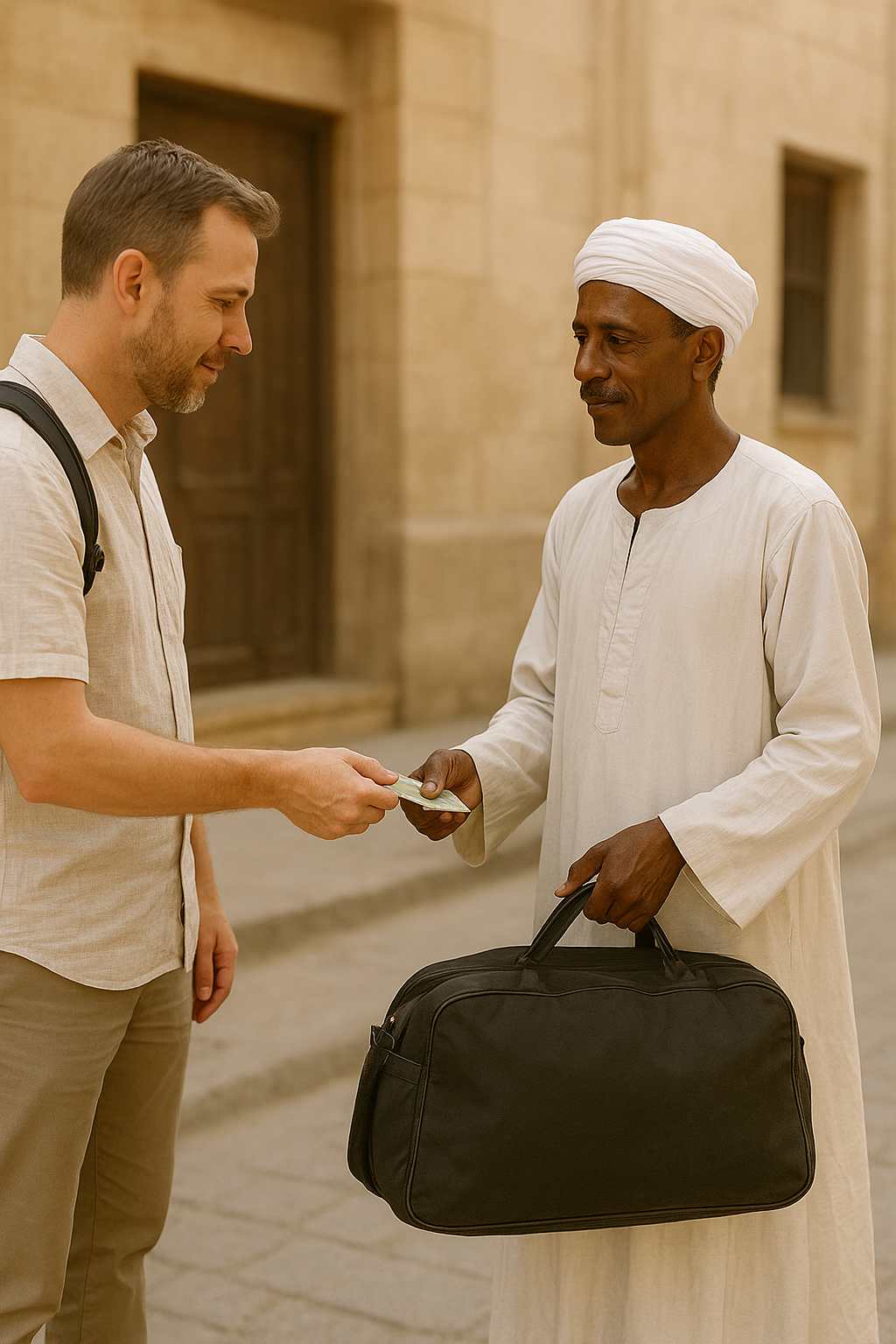
In all situations, except when you’re directly settling the bill in a restaurant, it’s customary to discreetly fold the tip in the palm of your hand and offer it subtly during a handshake while expressing your gratitude. It’s generally seen as impolite to wave the tip in the air and hand it over to someone, such as a guide or housekeeper, as if you were making a payment. Some Egyptians view it as a display of good manners to initially decline the tip once or twice, so it’s considered polite on your part to insist while expressing your sincere thanks.
Be aware that foreign coins are not exchangeable or spendable in Egypt so please do not use foreign coins for tipping. If you are stopped in the street by someone holding a handful of coins, they are asking you to exchange them for Egyptian pounds. They have been keeping them until they find someone who will change the coins for them. This can be an annoyance but changing them is a kindness.
Exceptions to Tipping: When It’s Not Required
- Police or security personnel.
- Guardians in temples (avoid those offering to show something special like the plague because they will continue to plague you until you leave).
- Guardians in tombs offering to let you take photos (you can do this without their permission and avoid potential hassles).
- Street food vendors (though I advise against eating street food due to hygiene).
- Anyone in airports except baggage handlers who actually load and push your trolley. Be wary of someone meeting you at the door going into the airport, unless you have pre-arranged it, offering to fast-track you through check-in, this is a trick and can turn into an unpleasant encounter.
Conclusion
I am sure there is a better way to phrase my final thoughts this morning and my metaphysical musings may well be a bridge too far for some to take.
- If you feel you can’t afford to tip – don’t come to Egypt until you can afford it – save yourself the misery of feeling bad 50 times a day. An average stay of 14 nights in Egypt would take about $250 in tips.
- How we speak about our abundance or lack of it in regard to paying anyone anywhere for anything tells the world more about us than we realise. This applies to how we speak about EVERYTHING. We speak our reality into manifiestation. The world is not something coming at us – we build it with our words. Everything around us is simply a reflection of where we are inside. This is not meant to be a spiritual lecture but I need to add an addendum here – when bad things happen, such as losing a job or a way of earning, that is usually a sign it is time to change paths, and that is always a good thing – eventually.
- If you feel abundant – spread the joy around, and it will come back to you – but it must be from the heart.
HAVE A WONDERFUL TRIP!
The Economic Crisis in Egypt Raises Another Dilemma: Tipping – NY Times Nov 2025
Last updated on 17/05/2026 by Marie Vaughan