
How the cheap tours make their money
A $45 or even a $75 day tour doesn’t cover its own costs on the tour fee alone. A private vehicle, a driver, a licensed guide, fuel, entrance fees, transfer permits and insurance cost more than that to provide.
The gap is closed in a few places – through the entry tickets you thought were included but were not, through the use of a car not licensed to work with tourists, through not finishing the itinerary and – through commission:
- Papyrus factories,
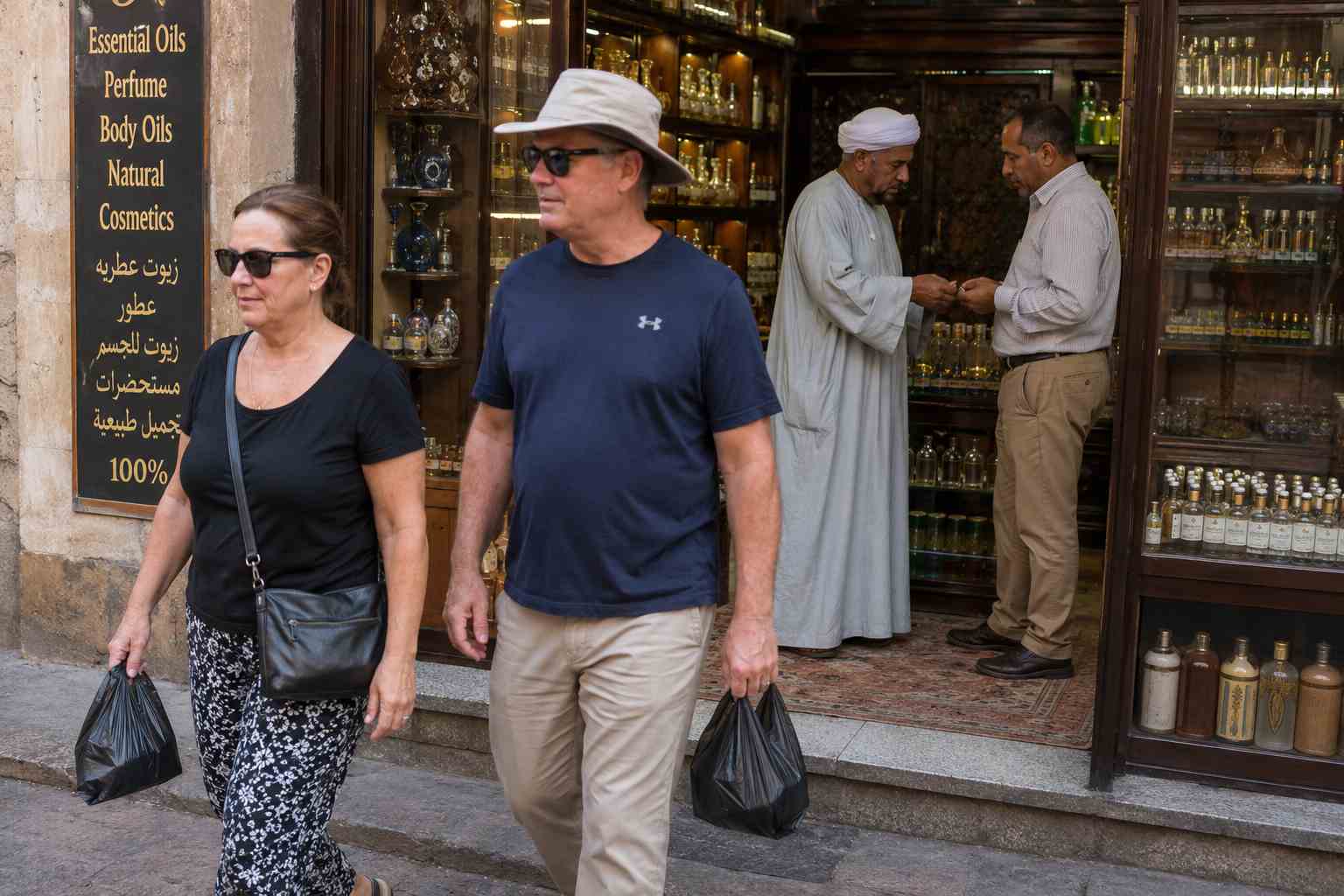
- perfume shops,
- alabaster workshops,
- jewellery stores.
- Restaurants where the food is cheap but the price isn’t, or where the meal is substandard and is free – but look what you’re paying for your beer, coke. extras.
- The motor boat you’re told at the last minute you have to pay for.
- The taxi to the site you have to pay for.
- The last-minute change you’re expected to just accept.
- And the sad face at the end of the day because your tip wasn’t big enough – except you were thinking of your tip as a fraction of what the tour itself cost, and the tour itself was cheap precisely because of all of this.
And the biggest pushers of the commission system are the big online tour booking platforms because the guide you book there has to cover the cost of the tour, his wages (don’t even bother taking about profit).
What it costs you, without you ever knowing
Two versions of the same day exist everywhere in Egypt – at the pyramids, at the temples, on the river, in the markets.
One version moves at the pace of the sites and your pace,
The other moves at the pace of the shops, and the sites get whatever time is left over once the shops have taken theirs.
Over a longer trip, this compounds. How many hours of your one trip to Egypt can be swallowed up, a few minutes at a time, by commission-heavy touring? And here’s the part that should unsettle you: as a tourist arriving unprepared and booking the cheap version, you have no way of knowing what you were deprived of. You don’t get to see the day you didn’t have.
My clients have the exact opposite experience – they don’t get to fall into the tourist traps or know about the disasters and disappointments they avoided – just because they came through me.
What it does to your guide
On a commission tour, the largest part of your guide’s income depends on what you buy. That shapes the day, no matter how good or honest the individual guide is. It’s built into the structure of the system, not the person.
One guide who’d worked the commission circuit for years described it to me bluntly: a slavery system. His word, not mine – but it tells you something about how it actually feels from inside it. Where the guide trades his integrity and dignity for commission.
This is true especially on the big online tour platforms. They set up systems that make you think booking a holiday or a guide just got easier – and cheaper. But at what cost? The platforms have the guides competing on price, then take an exorbitant fee per booking from the price set by the guide – so the shopping stops aren’t optional extras the guide chose. They’re how he survives the fee the platform already took from him and the expenses he should pay for such as transport and tickets. I particularly dislike these platforms for exactly this reason: the commission they charge the guide is what forces him and you into the shopping trap in the first place.
And every time a cheap tour gets booked, that system gets a vote of confidence to keep going.
What I did instead – and what I was afraid would happen
When I first started selling tours in Egypt, I consistently wrote that there was no shopping on my tours and how it worked. Every day, I half expected someone to knock on the door about it, somebody telling me I couldn’t do business that way.
Nobody ever did.
Clients who knew the value of their time came flocking to me instead.
Over time I stopped writing about it. Commission was never part of my business plan, so there was nothing left to say. I was just too busy booking and looking after clients doing my 2 Days Tours in Cairo and my 3 Days Tours in Luxor to think about it any more, so the subject went from my mind.
I’m picking it back up now because of what I notice in the emails that land in front of me. Visitors aren’t always sure where their priorities actually lie when they’re planning a trip – and the moment that uncertainty sets in, cost quietly becomes the deciding factor by default. Not because anyone chose it deliberately, but because it’s the only variable left standing once everything else feels unclear.
So this is me clarifying the difference between a cheap, commission-led tour and a genuine value experience – for anyone planning this trip who has lost their compass somewhere in the process. This is me telling you that you cannot compare my offers or my quotes to a similar itinerary provide by another company because – while you believe you are comparing like with like – in reality there is no comparison.
It’s blunt. It isn’t meant to be a soft piece of writing. It’s meant to shine a light for people floundering in the dark truly not knowing how to compare their research.
My Guides on Your Tours
The guides I work with are on a fixed daily rate. They don’t like the commission system, and that’s part of why they choose to work the way I work. They’re qualified professionals, always updating their skills and knowledge, learning as much from you as you’re learning from them. They’re proud of what they’ve achieved and the caliber of client they get to work with because only discerning clients end up booking with me.
I realise that when people ask me about tipping in Egypt – they may be asking the wrong questions because they don’t know the commission system. Rather than “How much should I tip my guide?” should the question be, “What is it worth to have a guide who spent the day looking after me instead of trying to sell to me?” That awareness takes the tipping question into a totally different space.
The physical cost
Egypt is demanding on the body. In Luxor in summer, the Valley of the Kings can swing from around 26°C at dawn to 40°C by late morning – and feel closer to 44°C on the open paths between the tombs.
You only have so much energy in a day. A shopping stop doesn’t give any of it back. It just spends what you needed for the place you actually flew here to see.
What anyone who lives here can see
Live in Egypt long enough, Egyptian or foreigner, and you start to be able to spot it from across a street. A tourist being moved from shop to shop, smiling because they think this is the trip, having no idea what they’re not seeing. Yes I am being extremely blunt again, but there’s a word everyone who lives here uses for it, the word is “donkey”
It isn’t said to be cruel. It’s said because it’s exactly what it looks like from outside the tour.
What should your questions be now?
The questions now for you should be – not which tour is the cheapest. Your questions for yourself should be
- What am I really paying for this tour at the end of the day?
- And what’s in it for me?
- What am I going to Egypt for? Experience? Sightseeing? Bucket List? Shopping?
On a cheap tour, you pay for sites and shops. On a properly priced direct tour, you pay more and should get only the sites. Either way, the real currency is time – and the time at stake is made up of the minutes of your own life.
- What value do you put on the minutes you lose standing in an alabaster shop?+
- What do you actually deserve from a trip you may only take once?
So, what’s the alternative? Honestly? Taka a look at how I help my clients plan their trip – you have options – and, with me you won’t have to be on your guard during every one of your day tours.
Last updated on 14/08/2026 by Marie Vaughan