
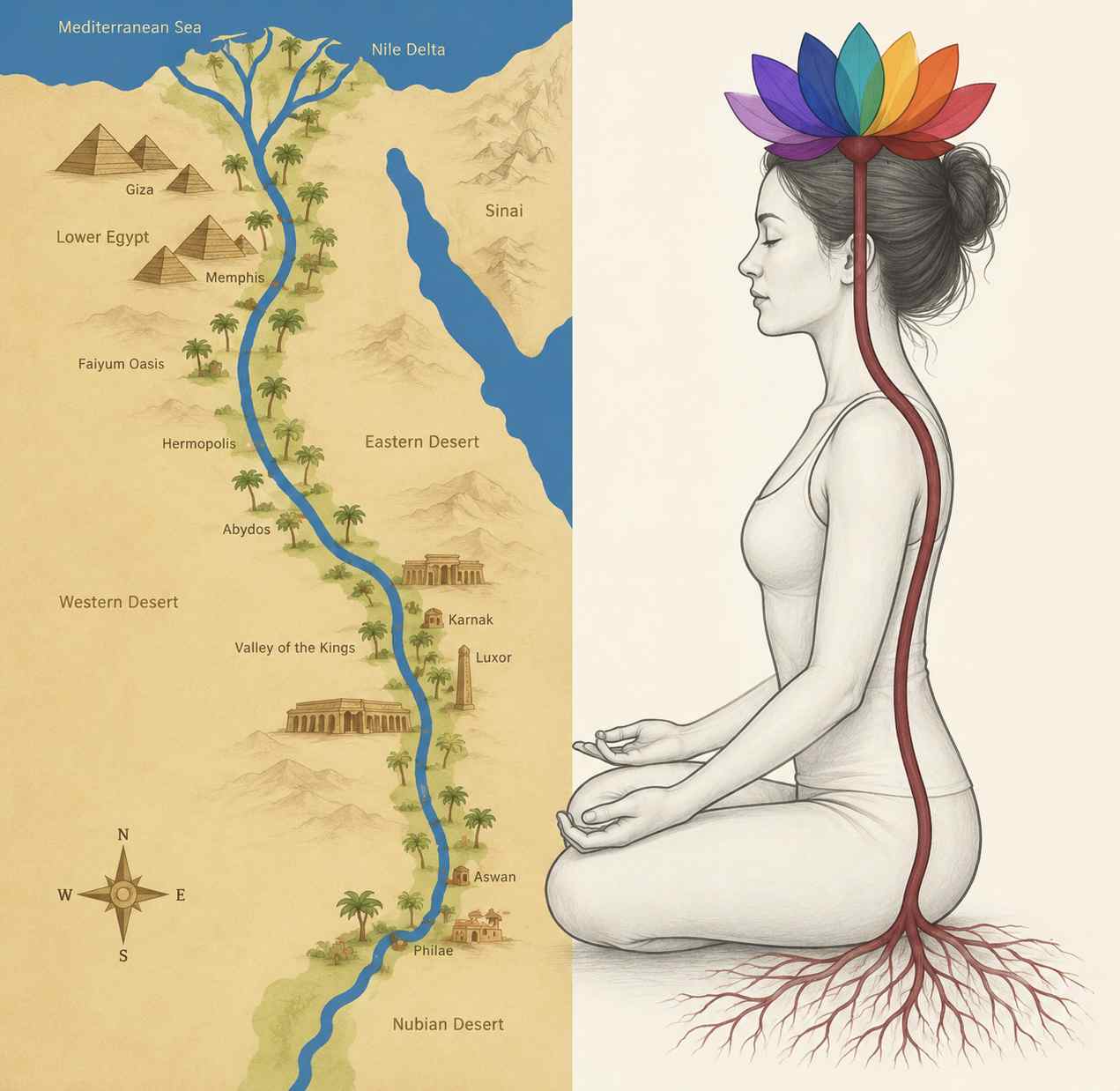
A Continuous Overland Journey from the Sands of Abu Simbel to the Shores of Alexandria
Here is the schedule for the Nile Chakra Expedition and each day includes just a little seed to think about in relation to the sites we visit and the road we will travel each day. This will be a very individual journey for everyone where your own personal daily insights and understandings will arise from the energy of the sites and the information shared by your facilitators and guides.
- Note from Mara • This is a journey I felt called to create. What has kept me in Egypt all these years was not comfort, business or love for the life here. It is a feeling of being able to tap into some unseen dimension/s. Not just in the temples – everywhere. Many visitors come expecting to feel something extraordinary in the sacred sites – not everyone does because perhaps the excitement and expectation is too great. Where many feel an indescribable connection is in the ordinary – sitting having tea in the souk watching people pass by, or driving through the farmland – in the relaxed moments when not trying to tap into anything – that’s when the magic happens. That’s what keeps me here and that is what I am sharing with you. This is a road trip – and a long drive where the mind relaxes, is a perfect catalyst to opening to the invisible
DAY 1 • Aswan • Root • Survival
We arrive, we settle, we get acclimatised to each other and the city. We are taking time out from the life we have known and feel a sense of excitement that we are going on an actual adventure. Yes, we have a map, yes, we have a schedule. But this journey is real, authentic, organic and we are open to being introduced to the extraordinary, to schedule changes, to going off track if guided to do so. This is not a manufactured luxury trip. It’s Indiana Jones and Lara Croft going in search of themselves. The transition from everyday life into the expedition begins here.
DAY 2 • Abu Simbel • Root
Deep in the southern desert, Ramses II’s love for Nefertari brought him from the fertile lands of Thebes to build two temples to the gods, here in both their names. Both later moved entirely to save them from the rising waters of the Nile behind the Dam. Two feats of engineering, one ancient, one modern. The buildings were extraordinary feats of engineering and craft in the days of Ramses II, but the modern task of moving the temples was something else. Preservation is a theme running through both the original building projects – preserving their love – and preserving the physical structure in modern times. Survival. But also immense power.
Explore more:
DAY 3 • Philae • Survival/Safety • Mother Love
The island setting creates separation from land, bringing softness, reflection, and emotional openness dedicated to the goddess Isis. A symbol of an oasis of peace in the midst of chaos and danger. Still telling a story of survival as the original island is where the goddess, as legend tells us, fled with her son Horus to escape the clutches of Set. Even though the temple is not in it’s original location, it still feels very special, peaceful and – something outside of time – about it.
Explore more:
- The Island of Isis: Where the Stones Still Whisper
- Isis & Osiris — Love, Loss, and the Underworld
- The Egyptian Story of Creation
DAY 4 • Kom Ombo • Sacral • Edfu • Esna
Kom Ombo – the temple of two gods sharing one house: Sobek the crocodile, Horus the falcon. Duality held in stone, instinct and form sharing space without resolving into one. An ancient temple of initiation where the priests in training faced both their fear of the unknown and then the known. In the early days I once had a group that also traveled through the underground initiation tunnels – that was when I myself had no fear – because I was totally unaware of any danger.
EDFU & ESNA — the road between
Two temples mark a long drive north. Edfu’s mythic struggle, Esna’s hidden descent. Edfu whose walls tell the entire story of courage – the story of Horus’s fight and ultimate victory over his uncle Set when he avenged the murder of his father Osiris. Then Esna where we enter the realms of magic – Heka.
DAY 5 • Karnak & Luxor • Solar Plexus • A Constant Power Struggle
Avenue of Sphinxes • Karnak Temple • Luxor Temple
We enter the great ceremonial centre of ancient Egypt both for the living and the dead. The East Bank for the living and the West Bank for those on their journey to the Afterlife.
Massive columns, processional routes, cosmic architecture. In ancient Egypt ceremony was everything, ritual was daily, regardless of the level of faith or devotion of the ruling pharaoh. We meet personal power again – not alone in the desert this time, but inside the machinery of empire: court intrigue, priesthood, ceremony, the apparatus that holds a civilisation’s will together. Think about the busyness of life on the East Bank with the subtle quiet, hidden work being carried out in the Valley of the Kings. The cycle of life and death was natural and ever present in the minds of the ancients. And while many went about their daily routine undisturbed by questions – those who had questions, regardless of status, were free to ask and pursue the answers to as deep a level of knowledge as they were able for.
Explore more:
- Amun – The God Who Rose to Rule the Egyptian Empire
- The Moment the Temple Becomes the Library – Karnak
- Karnak Temple: Where Time Is a River You Can Step Into
- Luxor Temple: The Temple in Man
- In the Hidden Sanctuary: A Meeting with Sekhmet
- Sekhmet: Egypt’s Fierce Goddess of Power
DAY 6 • The West Bank
Valley of the Kings • Hatshepsut Temple • Medinet Habu • Workers Village • Colossi of Memnon • Nobles Tombs
Tombs, silence, ancestral presence. In modern times we are re-discovering ancient knowledge about cellular memory, inherited ancestral trauma and the value of healing family trees. Ancient Thebes and modern Luxor is a conundrum, not only layers upon layers of history but also layers of awareness and the interconnectedness of dimensions. After all my years living here I can still say that no two days are ever the same – and for a restless soul like mine, that is part of what holds me here – it may all seem the same on the outside but it is never the same.
Explore more:
- Medinet Habu Temple on the West Bank – A Civilization Under Strain
- Hatshepsut – a woman in a man’s world
- The Narrow Gate of Destiny: Thutmose III at Megiddo
- Ancient Echoes: The Eerie Vibes of Thutmose III’s Tomb
- Was Yuya Really Joseph from the Bible?
DAY 7 • Dendera & Abydos • The Heart Bridge
Dendera • Osirion at Abydos (Private Access to the Osirion)
Two temples, two aspects of the heart. At Dendera, the joyful, musical, life-affirming frequency of Hathor – sound, vibration, healing. At Abydos, something heavier: ancestral, masculine, holding its secrets shut against every modern attempt to open them. It drew Omm Sety back to her past life. It fascinated Margaret Murray. It drew me, from my first visit, and continues to draw more women than men here, for reasons I still can’t fully name. Together, the full emotional spectrum – joy and grief, male and female balance – set in stone.
Explore more:
DAY 8 • Tel el-Amarna • The Visionary Heart
Akhenaten’s City – A short-lived city of radical vision and rupture. Idealism and collapse, side by side. Standing at the door of the Royal Tomb several years ago, looking out over the gap in the horizon, I understood and felt the priest energy for myself – suddenly, physically – and understood why Akhenaten chose this valley. Nobody comes here. The road itself seems to agree: a four-hour drive that, the one time I brought a group from Cairo, took just under eight and included a river crossing on a boat straight out of an Indiana Jones movie that I had not been told about in advance, and a bus ready to fall apart waiting on the other side… Yet, the journey back was still only four hours. None of us can explain why.
DAY 9 • Cairo • Layers of Civilisation
GEM Grand Egyptian Museum • Coptic Cairo
The city is sensory overload – traffic, colour, noise, everything flashing past, much like our own lives. From the day I first walked through the Treasures of Tutankhamun, one image has never left me: the tiny mummified remains of his two infant daughters, buried with him so they would not face eternity alone. A pharaoh surrounded by gold, and still, underneath it, a father.
Way up in the Moqattam Hills, hollowed from the rock by bare hands, we will find the Cave Cathedral in the heart of the mountain that moved. It holds nothing but timber seats, carved stone and silence, and then your eyes turn to look up through the mouth of the cave to find the open sky. This place of worship in the heart of the homes of the garbage collectors of Cairo is solitary and unique. Everywhere your gaze wanders here finds a unique piece of art born of faith, raw talent and devotion. There is a lot to think about in this place, not least of which is the welcome afforded to visitors.
Explore more:
DAY 10 • Saqqara • Throat • Whisper of Stone
Step Pyramid Complex • Subterranean Passages
Known to many as a healing temple of sound – the carved reed ceiling at the entrance, the silence beyond. But these days the site that draws my attention isn’t the Step Pyramid, it’s the Serapeum: vast boxes of solid granite, too heavy to move even with modern equipment, sealed in tunnels below the desert. One box bears a smooth, deep dent, as if something enormous once leaned its full weight into the stone. Elsewhere the rock has been bored through with such force it’s turned to glass. I don’t have an explanation and am not sure I am ready for one. This is another place, open to the public, but few people visit.
Explore more:
DAY 11 • Giza Plateau • Third Eye
Pyramids • Sphinx • Private Access to the Gt. Pyramid
Pyramids, Sphinx, private access. We see the plateau twice – the hustle of the day, then a deserted plateau under the stars for our private night visit. The same site, twice over, in two entirely different lights. What else changes when we simply look again? Tonight is probably the highlight of the visit for everyone. 2 hours after dark, without the crowds, inside the Gt. Pyramid – the Grand Gallery, the King’s Chamber, the Queen’s Chamber and the subterranean chamber known as “The Pit”.
Explore more:
DAY 12 • Abu Ghorab • Heliopolis • Nile Delta: Third Eye to Crown
Solar Temple • Obelisk Site • Virgin Mary’s Tree • Tanta • Drive to Alexandria • Private Access to Abu Ghorab
By now we have travelled the route everyone knows. Today we leave it. Abu Ghorab’s solar temple is barely visited and barely written about – a place built for a sun cult that burned bright and vanished almost as fast, leaving a temple most travelers to Egypt will never hear of, let alone stand inside. A few miles on, a single obelisk marks where Heliopolis once stood: a city of priests and sun-worship that rivalled Thebes for power, now reduced to one stone and a name on a map. At Matareyah, tradition holds that the Holy Family sheltered beneath a tree on their flight into Egypt – sacred geography laid quietly on top of older sacred geography, the way it so often is here. Then north through Tanta, into the Delta, where the Nile stops being one river and becomes many, fanning out toward the sea exactly as it has for thousands of years.
I know this route because I have studied it, not because I have worn it smooth with my own footsteps the way I have the road to Abydos or the path through Karnak. If you travel this day with me, that is exactly what it will be: a day where my fascination is doing the leading rather than my memory – and where what we notice together is genuinely first for both of us. Some places are extraordinary because of what’s known about them. This one is extraordinary partly because so little is.
DAY 13 • Alexandria • Crown • Convergence
Alexandria doesn’t look like the postcard. The harbour is workaday, the streets ordinary, the great Library and the Lighthouse gone, scattered or sunk centuries ago. There is nothing here that announces itself the way the temples do. You have to close your eyes to find the jewel still there, layered under all of it. I’ve stood on that coast and felt the line between what’s visible and what isn’t wear thin in a way I can’t fully account for – not dramatic, not a single moment, more like static at the edge of hearing. It doesn’t arrive for you the way it sometimes does in the south. You have to be still enough to let it. After thirteen days of temples built to be seen, Alexandria asks you to find what was built to be remembered instead. Everything the journey has touched comes to rest here, where the river finally lets go.
DAY 14 • Departure
Transfer Day • Cairo Airport
Root to crown, desert to delta, fourteen days that ask nothing of you except to stay open to what each one brings. Some of it you will be able to name. Some of it, like the road to Amarna, you may never quite explain – and that, more than any single temple, is the journey.
*****
If this is the trip calling to you, the next step is simple: just answer a few questions and let’s see where it takes us.
Travel Schedule in brief –
| Day | Site Visits | Overnight |
| Day 1 | Arrive, Meet and Greet at Aswan Airport, Transfer to Hotel | Aswan |
| Day 2 | Drive to Abu Simbel and visit the two temples | Aswan |
| Day 3 | Morning visit to Philae Island | Aswan |
| Day 4 | Drive to Kom Ombo, Edfu, Esna, arrive Luxor | Mara House Luxor |
| Day 5 | Karnak and Luxor Temples | Mara House Luxor |
| Day 6 | The West Bank | Mara House Luxor |
| Day 7 | Drive to Dendera then onto Abydos | Abydos |
| Day 8 | Drive to Tel El Amarna | El Minya |
| Day 9 | Drive from El Minya to Cairo | Cairo |
| Day 10 | Morning visit to Saqqara | Cairo |
| Day 11 | Morning visit to the Giza Plateau. Private Visit Gt. Pyramid | Cairo |
| Day 12 | Private Visit Abu Ghorab, drive through Heliopolis, Matarayah, Tanta | Alexandria |
| Day 13 | Visit the sites of Alexandria | Alexandria |
| Day 14 | Departure | — |
What’s Included
- 13 nights’ accommodation (3 Aswan, 3 Luxor, 1 Abydos, 1 El Minya, 3 Cairo, 2 Alexandria)
- Daily breakfasts
- Private visits to: Great Pyramid (all chambers), Sphinx enclosure, Osirion at Abydos, Abu Rawash
- All transfers, entry fees, and permits per itinerary
- Sightseeing by air-conditioned vehicles
- Guided tours with a licensed Egyptologist
- Tour Facilitator: Mara accompanies you throughout
- Cultural immersion opportunities
- Hotel taxes, fees & service charges
Not Included
- International flights
- Tipping (guide)
- Meals and drinks unless specified
- Extra nights in Cairo or Aswan
Cost – €5700 per person sharing accommodation
Solo Travelers
This journey is especially welcoming for solo Seekers. Rooms can be shared with fellow travelers to avoid single supplements. The single supplement is €900.